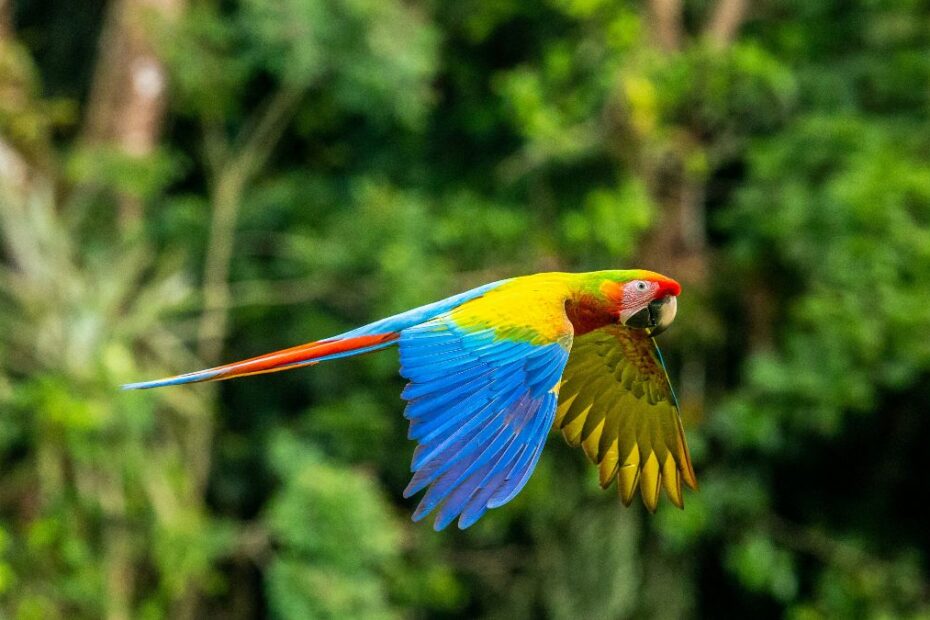
Central America is one of the most important birding regions in the world, linking North and South America and hosting an extraordinary concentration of species in a relatively small area. This guide highlights the best birdwatching in Central America on a country-by-country basis.
Sitting at the crossroads of North and South America, the Central American isthmus is one of the world’s most important biological corridors for birdlife. Its position along major migration routes, combined with dramatic changes in elevation over short distances, has produced an unusually high concentration of species across a relatively small region. Cloud forests, lowland rainforest, wetlands, savannas, and more all exist within a few hours of one another, creating conditions that support both resident and migratory birds year-round.
Because of this diversity, birdwatching in Central America is less about covering entire countries and more about choosing the right destinations. Two places within the same country can host completely different bird communities, while a single well-placed reserve may offer higher species totals than an entire region elsewhere in the world. This means that for birders planning wildlife trips in the region, it’s about finding standout habitats and proven hotspots to get the most out of their visit to any particular country.
Below are the locations offering some of the best birdwatching in Central America. We’ve basically chosen one top birdwatching destination in each Central American country for you to check out:
Crooked Tree Wildlife Sanctuary, Belize
Those in the know regard the Crooked Tree Wildlife Sanctuary in Belize District as the country’s top birdwatching destination, particularly for waterbirds and wetland species. The reserve protects a mosaic of lagoons, creeks, swamps, pine savanna, and broadleaf forest, creating one of the most species-rich birding environments in Belize. More than 250–300 resident and migratory species have been recorded here, with dramatic concentrations forming as water levels recede during the dry season.
Crooked Tree is best known for its large and easily observed waterbirds. The Jabiru Stork is the flagship species, regularly feeding in low water areas and nesting in nearby savannas. Other notable species include the Roseate Spoonbill, Wood Stork, Agami Heron, Boat-Billed Heron, Bare-Throated Tiger Heron, Limpkin, Northern Jacana, and large numbers of ducks, egrets, and waders. Raptors including Black-Collared Hawks, Snail Kites, and ospreys are common, while all four Central American kingfishers can be found along the lagoons and creeks.
Forest edges and savanna habitats add further diversity, with parrots, jacamars, tanagers, flycatchers, orioles, and seasonal North American migrants. Birding is strongest between roughly February and May, when falling water levels concentrate birds into smaller feeding areas.
Most visitors stay in Crooked Tree Village, where small lodges on the lagoon run dawn and dusk boat trips that reach the best viewing zones with minimal logistics.
View this post on Instagram
La Selva Biological Station, Costa Rica
If there’s one place that most closely fits the idea of a single “best” birdwatching destination in Costa Rica, La Selva Biological Station in Sarapiquí could well be the place. Located near Puerto Viejo de Saripiqui, in the northeast of the country, the site protects a large block of Caribbean lowland rainforest and edge habitats and has one of the highest species totals of any single location in the country. Some 460–470 bird species have been recorded here, representing more than half of Costa Rica’s total bird list.
La Selva is designed around research and birding access. Its network of well-maintained trails crosses primary and secondary forest, wetlands, rivers, and open areas, creating ideal conditions for high species diversity in a compact area. Guided “early birding” walks are a long-standing part of the station’s program and are widely regarded as among the most productive in the country. Serious birders regularly log dozens of species in a single morning, with exceptionally high day totals possible.
Signature species include Great Curassow, Crested Guan, Snowy Cotinga, several toucans and aracaris, trogons, motmots, manakins, and a wide range of antbirds, tanagers, hummingbirds, and raptors. Both resident and migratory species are well represented, and the mix changes seasonally without ever dropping in quality.
La Selva is a true year-round site, but late February through June offers an especially strong balance of comfortable logistics, breeding activity, and high overall diversity. Its location roughly 1.5–2 hours northeast of San José also makes it one of the most accessible world-class birding sites in Central America.
View this post on Instagram
Montecristo National Park, El Salvador
Montecristo National Park is located in the northwest of El Salvador at the border with Guatemala and Honduras and protects a rare block of montane and cloud forest within the Trifinio Biosphere Reserve. Its broad elevation range, roughly 700 to 2,400 meters, creates multiple ecosystems in a compact area and supports around 260 recorded bird species. More than two dozen species documented in El Salvador are known only from this park, giving Montecristo outsized importance for highland bird conservation.
The park spans lower montane forest, pine–oak woodland, and cloud forest. This habitat diversity is what drives its exceptional birdlife, with over half of all species recorded here associated with the cloud-forest belt. Notable species include the Resplendent Quetzal, Emerald Toucanet, Scaled Antpitta, Tawny-Throated Leaftosser, Belted Flycatcher, Slate-Colored Solitaire, Common Bush-Tanager, and several highland finches and warblers. Raptors and owls like the Barred Forest Falcon, Whiskered Screech-Owl, and Ferruginous Pygmy-Owl are also present.
Birding is most practical in the dry season from roughly November through April, when road access is reliable. Entry is regulated by permit, and a 4×4 vehicle is strongly recommended to reach the main forest zone near Los Planes. Staying inside the park allows early and late-day access to the richest cloud-forest trails, where many of the park’s most sought-after species occur.
View this post on Instagram
Tikal National Park, Guatemala
Perhaps more famous for its fantastic Mayan ruins, Tikal National Park in northern Petén also protects over 57,000 hectares of intact lowland rainforest and supports one of the richest bird lists in Guatemala, with well over 300 species recorded. Indeed, birding guides regularly cite totals of 375–400+ on multi-day visits. Its combination of large, continuous habitat, protected status, and established birding infrastructure makes it the most consistent single site for high species diversity.
The park contains a mix of mature rainforest, forest edges, ponds, old clearings, and access roads, allowing birders to work both interior and edge habitats in a compact area. Key birding zones include the temple complex and surrounding trails, the forest around the on-site lodges, and the drier open areas near the access road and former airstrip, which add a different species mix.
Ocellated Turkeys and Great Curassows are among the signature birds to spot at Tikal, especially around clearings, as well as Keel-billed Toucans, Tody Motmots, trogons, woodcreepers, parrots, Yucatán Jays and Rose-Throated Tanagers. Bat Falcons, Ornate Hawk-Eagles, and King Vultures are also recorded. Nocturnal birding is particularly productive, with owls, potoos, and nightjars frequently seen along park roads.
Tikal can be birded year-round, but the drier months from roughly December through April offer the most comfortable conditions and easiest logistics, while still delivering very high species totals.
View this post on Instagram
Lake Yojoa & Cerro Azul Meámbar (PANACAM), Honduras
At the heart of Honduras’s birding scene is the Lake Yojoa basin, where wetlands, forest edge, and cloud forest come together in a single, compact region. Ringed by the Cerro Azul Meámbar National Park (PANACAM) and Santa Bárbara National Park, the area supports over 400 recorded bird species, making it the most productive birding hub in Honduras.
The lake itself offers easy access to waterbirds and raptors, while the nearby PANACAM Lodge trails climb quickly into cloud forest, adding a completely different species mix. Rowboat trips through the marshy canals reveal Northern Jacanas, Snail Kites, Whistling Ducks, herons, and spoonbills. Higher on the slopes, birders encounter toucans, trogons, motmots, manakins, guans, and a wide range of hummingbirds and tanagers. Migration further boosts diversity on the lower PANACAM loops and around Los Naranjos, where winter warblers and waterfowl pass through seasonally.
With a guide, daily totals of 100+ species are common, especially between December and April when dry weather overlaps with northern migrants. Most visitors base themselves at PANACAM Lodge or along the lake, allowing early starts in both wetland and forest habitats without long transfers.
View this post on Instagram
Montibelli Private Wildlife Reserve, Nicaragua
The Montibelli Private Wildlife Reserve outside of Managua protects a compact block of tropical dry forest that delivers some of the most accessible birding in Nicaragua. Covering some 160 hectares, the reserve has recorded roughly 150–175 bird species and is valued for offering strong diversity in a small, easy-to-navigate area. Its location near the capital makes it a practical base for both visiting birders and travelers with limited time.
The reserve’s dry-forest habitat supports a different species mix than the country’s Caribbean rainforests. Motmots, trogons, toucans, parakeets, hummingbirds, flycatchers, and warblers are all regularly encountered along the trail network. The Turquoise-Browed Motmot, Nicaragua’s national bird, is one of the most reliable sightings here, alongside the Lesson’s Motmot, Collared Aracari, Keel-billed Toucan, Hooded Warbler, Black-faced Solitaire, and a variety of hummingbird species, including the Rufous-tailed Hummingbird. Open viewpoints along the trails also attract Red-billed Pigeons and other canopy species.
Montibelli’s marked trails cover roughly 3–4 kilometers and climb to overlooks with views toward Volcán Masaya. Guided walks help spot quieter or canopy species, especially in the early morning or late afternoon when activity is highest.
Birding here is most productive during the dry season from roughly November through April, with February and March offering an especially good overlap of resident birds and migrants before heavier rains arrive.
View this post on Instagram
Pipeline Road (Soberanía National Park), Panama
Few birding locations in the world have been studied, visited, and written about as extensively as the Pipeline Road. Running through lowland rainforest in Soberanía National Park along the Panama Canal, this narrow service road has become one of the most famous birdwatching sites on the planet, known for exceptional species density and record-setting bird counts. Over 400 bird species have been documented in the surrounding area, and single-day counts here have reached levels unmatched elsewhere.
Pipeline Road cuts through mature rainforest and offers rare access to interior forest, canopy, and wetland-edge habitats in a short, walkable stretch. Mixed flocks move constantly through the trees, and army-ant swarms draw some of the region’s most sought-after understory birds. Species frequently reported include Ocellated, Spotted, Bicolored, and Chestnut-backed Antbirds, Rufous-vented Ground-Cuckoo, Streak-chested Antpitta, multiple trogons, Great Jacamar, Keel-billed Toucan, manakins, puffbirds, motmots, tanagers, and a wide range of raptors and hummingbirds.
The road is flat and quiet, making it ideal for slow, early-morning walks. Dawn is the most productive time, when mixed flocks and ant followers are most active. January through March is generally the most comfortable period, with drier conditions and high overall diversity, although birding is productive year-round. Its location less than an hour from Panama City makes Pipeline Road one of the most accessible world-class birding sites in Central America.
View this post on Instagram
Birdwatching Across Central America
It’s worth pointing out here that the destinations highlighted in this guide represent the most reliable starting points in each country, but they are far from the only places where excellent birding can be found. In fact, every country in Central America offers a wide range of world-class birdwatching locations in their rainforests, cloud forests, wetlands, and mountains. What sets these locations apart is their proven diversity, accessibility, and long-standing value for both resident and migratory birds.
As birdwatching becomes a more and more popular reason to visit Central America, responsible travel plays an important role in protecting these ecosystems. Supporting protected areas, local guides, and conservation programs helps ensure that these habitats remain intact and that bird populations are monitored and preserved for future generations.