From diapers and formula to baby medicine and wipes, here’s what parents should know about finding baby essentials in Central America.
Parents traveling or relocating to Central America with young children often assume they need to pack half a suitcase with diapers, formula, wipes, baby food, and medicine before they arrive. There’s often a perception of, for want of a better phrase, “first-world vs developing world” when it comes to baby essentials, and that can make parents anxious.
The truth is that families across Central America raise babies every day, and basics like diapers, wipes, standard formula, baby food, and common medications are no problem to find at all.
The real question parents ask is whether they’ll find the exact same products they’re used to at home. And that’s where things can get a touch more complicated. While major cities like San José, Panama City, and San Salvador offer plenty of options, selection often narrows once you head to smaller beach communities, islands, and rural areas. Specialty formula, organic baby food, specific diaper brands, and larger baby gear is also often harder to find, or more expensive.
In other words, you don’t need to overpack. But if your baby relies on very specific products, it’s worth planning ahead before heading to more remote parts of Central America.
What Baby Essentials are Easy to Find Almost Everywhere?
This is where parents can relax. Across Central America, basic baby consumables are widely available pretty much all over. You may not find the exact same brand you use at home, but you’re not going arrive down south and suddenly discover there are no diapers.
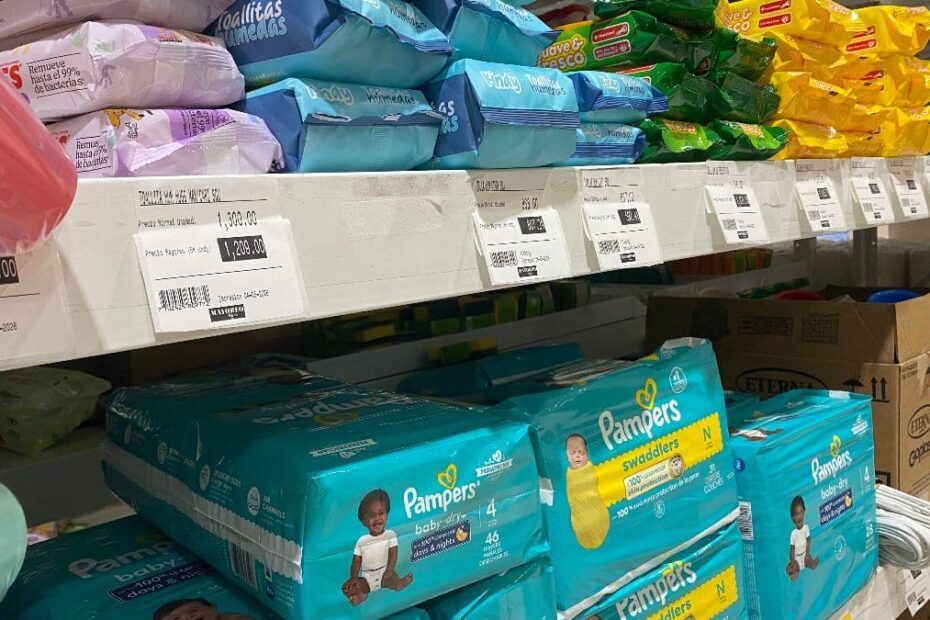
Supermarkets, pharmacies, and convenience stores throughout the region stock diapers, usually in multiple sizes and across both local and international brands. Prices and quality can vary, and parents loyal to specific brands like Pampers or Huggies may not always find their preferred option, but disposable diapers themselves are rarely difficult to locate.
Baby wipes are similarly easy to find, including standard scented and unscented options. More niche products like water wipes or ultra-sensitive varieties are harder to track down outside larger cities. Basic toiletries are also widely available. Baby shampoo, soap, lotion, diaper rash cream, and baby oil are standard pharmacy and supermarket items in every country.
Standard infant formula is also widely available. Most countries carry at least a few mainstream options in pharmacies and supermarkets, though the selection can narrow down once you move away from larger population centers. Baby bottles, pacifiers, sippy cups, and basic baby food are usually available as well, though with less variety. Larger supermarkets may carry jarred purees, pouches, and baby cereals, while smaller towns may offer fewer ready-made options. Many local families simply prepare their own baby food using fresh fruit and vegetables.
Basic health items like infant fever medication, saline drops, thermometers, and diaper creams are also easy to find. That said, many traveling parents still prefer to bring a small baby medical kit with products they already know and trust.
A Few Key Spanish Words or Phrases
Even if you’re staying somewhere with plenty of supermarkets and pharmacies, learning a few basic Spanish terms can make things easier, particularly in smaller towns where English may be limited:
- Diapers: pañales
- Baby wipes: toallitas húmedas
- Formula: fórmula para bebé
- Baby food: comida para bebé
- Baby bottle: biberón
- Pacifier: chupón or chupete (varies by country)
- Diaper rash cream: crema para rozaduras
- Fever medicine: medicina para la fiebre
In larger supermarkets and chain pharmacies in capital cities and major tourist area, you might find English-speaking staff. In smaller communities, having these terms saved on your phone can save time.
The bigger challenge in Central America isn’t about finding baby essentials rather than finding your exact preferred version of those essentials.
View this post on Instagram
Where Parents Can Run Into Problems
What can make things more complicated is when parents assume the exact same products they use at home will be easy to replace anywhere in Central America. That’s not always the case.
Specialty formula is one of the biggest potential issues, especially given recent safety concerns and Enfamil lawsuit cases making headlines at the moment. It’s something to consider when abroad. Standard formulas are widely available across the region, but hypoallergenic, soy-based, lactose-free, organic, or highly specific brands can be much harder to find outside major cities. Even when these products are available, they’re often significantly more expensive than they would be in the U.S., Canada, or Europe. And if your baby is sensitive to formula changes, this is not something you want to be troubleshooting mid-trip.
Organic and highly specialized products can also be harder to source. Families used to fragrance-free diapers, chemical-free wipes, organic baby snacks, European formulas, or niche supplements may find options much more limited, particularly outside major cities.
Large baby gear is another category where selection can narrow quickly. You’ll find high-end strollers, travel cribs, baby monitors, premium carriers, and specific car seat brands generally concentrated in larger cities, and often with higher import-driven price tags. Parents shouldn’t assume they’ll be able to quickly replace larger items if something gets lost, damaged, or forgotten.
Other Items to Think About
The same goes for medications and health products. Pharmacies are all over Central America, and generic versions of common medications are often widely available and cheaper than what parents are used to paying at home (while the exact brands they’re looking for might be much more expensive). The challenge is usually finding your exact preferred brand, specific dosage format, or more specialized products such as infant probiotics, allergy medications, or niche creams. Instructions may also only be in Spanish, which can add stress when you’re dealing with a sick child.
This doesn’t mean parents need to overpack. It simply means identifying the few products your child truly depends on and making sure those travel with you. For most families, that usually means specialty formula, prescription medication, and any highly specific products tied to allergies, sensitivities, or established routines.
Where Long-Term Expats Tend to Stock Up
If you’re relocating to Central America or staying for an extended period, most families quickly learn where the best-stocked supermarkets and pharmacies are for imported brands they recognize and bulk purchases.
- Belize: Brodies covers many basics, but many expats in northern Belize also cross into Chetumal to shop at Sam’s Club, Walmart, and Chedraui, or use the Corozal Free Zone for bulk goods
- Costa Rica: Auto Mercado is popular for imported products, while Walmart, Más x Menos, and PriceSmart are reliable for diapers, wipes, formula, and bulk purchases. Farmacias Fischel is a common pharmacy option
- El Salvador: Super Selectos, Walmart, and PriceSmart are common options, with Drogueria Santa Lucía widely used for medications
- Guatemala: Walmart, Paiz, and PriceSmart tend to offer the best selection, particularly around Guatemala City
- Honduras: Paiz and PriceSmart are useful in larger cities, where selection tends to be strongest
- Nicaragua: La Colonia and PriceSmart are common go-to options, particularly in Managua. Farmacias Kielsa is widely used
- Panama: Many expats rely on Riba Smith for imported goods, along with Super 99 and PriceSmart. Farmacias Arrocha is widely used for medications
For short-term travelers, this may be more information than you need. But for relocating families, knowing where to shop can make life much easier.
What Parents Should Bring From Home
As discussed, most families traveling to Central America don’t need to pack months’ worth of diapers, wipes, or baby food. Those basics are widely available across the region. What’s worth packing are the items that are either difficult to replace, tied to your baby’s routine, or simply stressful to search for when you’re in an unfamiliar place where you don’t speak the language.
- Your baby’s specific formula (or feeding setup). Standard formulas are widely available, but specialty, hypoallergenic, soy-based, lactose-free, or even simply “the exact brand that works” can be harder to find or significantly more expensive. Sudden formula changes can upset a baby’s stomach, and hunting for alternatives mid-trip is stress most parents don’t need.
- A small baby medical kit. Pack infant fever medication, any prescription medication, a thermometer, saline drops, a nasal aspirator, diaper rash cream, and basic first-aid supplies. Pharmacies are common across Central America, but brands, dosage instructions, and packaging may differ. Having familiar products on hand makes middle-of-the-night illnesses much easier to manage.
- Specialty items tied to sensitivities or routines. If your baby reacts badly to certain diapers, wipes, lotions, detergents, or soaps, bring enough of those products to avoid having to experiment with unfamiliar brands. The same applies to specialty feeding accessories, replacement bottle parts, breast pump accessories, specific pacifiers, and favorite toys or comfort items.
- Sun and mosquito protection. Parents traveling to tropical destinations should also think about baby-safe sunscreen, UPF clothing/hats, mosquito netting, and pediatrician-approved bug protection. Basic toiletries are easy to find, but highly specific products may not be. And as a practical aside, sunscreen in Central America is generally much more expensive than it is at home, so it’s worth packing enough for the adults in your group as well.
The Bottom Line
The main takeaway here is that you don’t need to pack half your house before bringing a baby to Central America. It’s easy to find basic essentials throughout the region, and local families navigate this every day. The bigger challenge is usually finding the exact brands or specialty products you may be used to at home.
Bring the items your child genuinely depends on, do a little extra planning if you’re heading somewhere remote, and you’ll likely find traveling or relocating with a baby here far easier than expected.