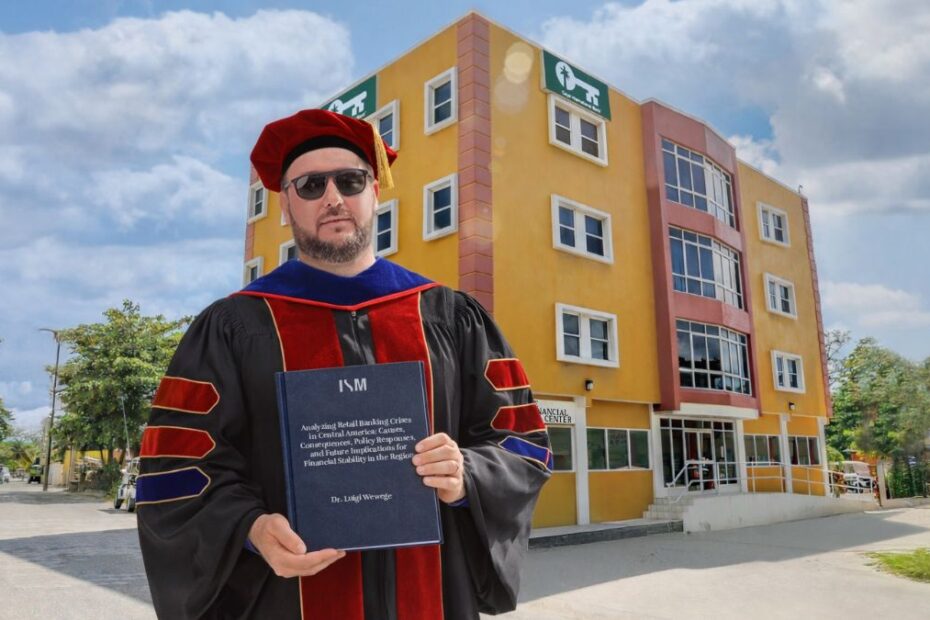
Dr. Luigi Wewege, President of Caye International Bank, earns his PhD with research focused on retail banking crises and financial stability in Central America.
Dr. Luigi Wewege, President of Caye International Bank in Belize, has officially been awarded his Doctor of Philosophy (PhD), marking the culmination of a multi-year academic journey dedicated to understanding and strengthening financial stability across Central America.
Dr. Wewege’s doctoral research was completed through the International School of Management in Paris and examined one of the region’s most critical and under-explored challenges: retail banking crises in Central America. His dissertation, Analyzing Retail Banking Crises in Central America: Causes, Consequences, Policy Responses, and Future Implications for Financial Stability in the Region, provides a comprehensive, evidence-based assessment of why banking disruptions occur, how they affect economies and households, and what policymakers and financial institutions can do to reduce future risks.
At a time when Central America continues to face structural vulnerabilities, ranging from limited financial inclusion and concentrated banking systems to external shocks and correspondent banking pressures, Dr. Wewege’s research offers timely and practical insights. The study integrated econometric analysis, historical case studies, and interviews with senior policymakers, regulators, and financial executives from across the region, bridging academic rigor with real-world experience.
“This doctorate was not pursued as a purely academic exercise,” says Dr. Wewege. “It was driven by a clear objective: to produce research that can meaningfully improve how financial systems in Central America are regulated, managed, and future-proofed.”
Understanding the Roots of Banking Crises
Dr. Wewege’s research identifies recurring structural weaknesses that have contributed to retail banking crises in Central America, including governance failures, regulatory gaps, over-concentration of credit, weak risk management frameworks, and delayed policy responses. Importantly, the dissertation highlights how these crises disproportionately affect everyday depositors, small businesses, and emerging middle classes — groups that rely most heavily on stable retail banking systems.
By systematically comparing crisis and non-crisis periods across multiple countries, the research moves beyond isolated case studies and instead offers a regional framework for understanding financial fragility. This comparative approach allows policymakers to distinguish between country-specific failures and region-wide systemic risks.
Practical Policy Implications for the Region
One of the defining features of Dr. Wewege’s doctorate is its applied focus. The research outlines clear policy recommendations aimed at strengthening financial resilience, including improvements to prudential supervision, early-warning indicators, crisis-management coordination, and depositor protection mechanisms. It also emphasizes the importance of transparency, institutional credibility, and regulatory independence in maintaining public confidence in the banking system.
For Central America, where confidence shocks can rapidly escalate into liquidity crises, these findings are especially relevant. The dissertation argues that proactive governance and regionally coordinated oversight can significantly reduce both the frequency and severity of future banking disruptions.
Bridging Academia and Practice
Dr. Wewege brings more than two decades of international banking, investment, and financial services experience to his academic work. As President of Caye International Bank, he has led the institution’s growth into the largest international bank in Belize while serving clients across multiple jurisdictions. This professional background informed the practical orientation of his doctoral research, ensuring its conclusions are grounded in operational realities rather than theory alone.
His work also contributes to the broader global conversation on financial stability, aligning Central America’s challenges with international regulatory standards while acknowledging the region’s unique economic and institutional context.
Looking Ahead to 2026 and Beyond
Dr. Wewege intends for his doctoral research to serve as a foundation for continued engagement with regulators, financial institutions, and academic audiences throughout Central America and the Caribbean. Future plans include policy briefings, academic publications, and applied frameworks designed to help banks and regulators translate research findings into action.
Further underscoring the academic and practical significance of this work, Dr. Wewege’s doctoral thesis has been accepted for publication as a full academic textbook by De Gruyter Brill, one of the world’s leading scholarly publishers. The forthcoming textbook will expand upon the dissertation’s findings and make them accessible to policymakers, regulators, academics, and financial practitioners globally, with a particular focus on emerging and frontier markets such as Central America.
“A stable banking system is not a luxury; it is a prerequisite for economic development, investment, and social mobility. If this research helps even one country avoid a future banking crisis, then the years of work invested in this doctorate will have been well worth it,” says Dr. Wewege.
By transforming his doctoral research into a widely distributed academic text, Dr. Wewege aims to ensure that the lessons drawn from Central America’s banking experiences contribute not only to regional reform efforts but also to the global body of knowledge on financial stability and crisis prevention.