Planning to eat conch in Belize or bring home a shell? Here’s how the fishing season works, why it can close early, and what the shell rules mean.
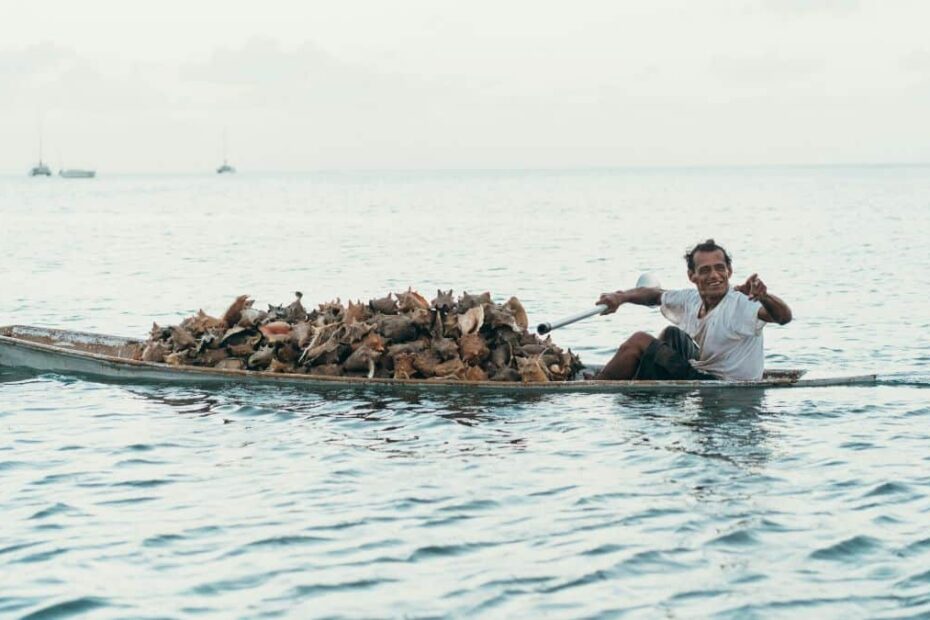
If you’ve spent any time in Belize, you’ve surely come across conch. You’ve tasted it chopped into ceviche, fried into fritters, or cooked into soup, and in restaurants and beach bars throughout the country. And you’ve seen the large pink shells themselves, sometimes piled outside restaurants or turned into jewelry and souvenirs.
Queen conch is native to the Caribbean and parts of the Gulf of Mexico, including the waters of several Central American countries. But few places in the region are as closely associated with it as Belize, where conch is both an important commercial fishery and a familiar part of the local food scene. Maybe only Key West in Florida and the Bahamas have bigger associations with conches than Belize.
Which brings us to the point of this article. We occasionally come across the odd social media query from travelers in Belize wondering why they can’t take conch out of the country or why it’s banned for part of the years. So we figured we’d clear that up for anyone who might be interested. Because Belize has set rules about when conch can be caught, sold, and eaten. There are also restrictions on the size of conch that can be harvested and rules to consider before taking a shell or conch souvenir out of the country.
So if you’re ordering conch ceviche, buying a shell as a souvenir, or wondering why conch suddenly disappeared from menus halfway through your trip, it helps to know how the rules work.
What Is Queen Conch and Why Does Belize Protect It?
Queen conch is a large marine snail, easily recognized by the pink interior of its shell. It lives in shallow tropical waters, particularly around seagrass beds, and has long been harvested for both its meat and its shell.
In Belize, conch is one of the country’s most important commercial fisheries, supporting fishers and beach communities as well as restaurants and the wider tourism industry. In fact, the Belize Fisheries Department calls queen conch the country’s second most important commercial fishery, behind spiny lobster (another Belizean product governed by a strict set of rules). Recent seasons have produced somewhere around 950,000 pounds of meat, most of it exported to the United States, earning Belize roughly US$8 million a year.
And exports aside, conch has been eaten in Belize for generations and remains a familiar ingredient in dishes all over the country.
But overfishing is a historic problem in Belize. Take too many conch, particularly younger ones that haven’t reproduced yet, and the population starts to suffer. Belize therefore controls both when conch can be caught and the size of the animals that can legally be harvested. It also limits the total amount that can be taken during each season.
The idea is to make sure enough conch survive to reproduce and keep the fishery going. During the open season, legally harvested conch remains widely available. Once the season closes, however, the rules become much stricter.
View this post on Instagram
When is Conch Season in Belize?
The official conch season in Belize runs from October 1 through June 30, with July, August, and September normally closed. But those dates can be misleading, because reaching June 30 isn’t guaranteed. Belize sets a national production quota for each conch season. Once it reaches that quota, the Belize Fisheries Department can close the season early, even if there are still weeks or months to go before the usual closing date.
That’s exactly what happened earlier this year. The 2025–2026 season ended on April 6 after Belize reached its production quota, almost three months before the normal June 30 closing date.
This matters if you’re visiting Belize and hoping to eat conch. If the quota has already been reached and the season closed, conch should no longer be available, regardless of what the calendar says. The same applies to people living in Belize. The closing date can change from one year to the next, so it’s worth paying attention to announcements from the Fisheries Department rather than assuming conch remains in season until the end of June.
What Happens When Conch Season Closes?
When conch season closes in Belize, it doesn’t simply mean the end of fishing. Restaurants, businesses, and even individuals also have to use, consume, or dispose of any conch meat they still have by the official closing date. That means restaurants can’t legally keep a supply of frozen conch and continue serving it through the closed season. The same rule applies at home, so stocking the freezer before the season ends isn’t a way around the closure either.
When the 2025–2026 season closed on April 6, for example, the Belize Fisheries Department warned that anyone found in possession of queen conch after that date could be charged and prosecuted under the country’s fisheries regulations.
Once the conch season closes, you shouldn’t expect to see conch on restaurant menus. If you’re offered conch during the closed season, you’re being offered it illegally and the fact that it was supposedly caught earlier and frozen doesn’t change that.
There are rules during the open season too. Queen conch shells must measure at least seven inches from end to end to be legally harvested, while minimum weights apply to conch meat once it has been removed from the shell and processed.
View this post on Instagram
Can You Take Conch Shells Home From Belize?
Yes, but you can’t simply assume that a conch shell you find or buy in Belize can go straight into your suitcase.
Queen conch has been listed under Appendix II of the Convention on International Trade in Endangered Species of Wild Fauna and Flora (CITES) since 1992. This means shells and other conch products can cross international borders, but there are rules and paperwork involved.
If you want to take a conch shell out of Belize, check with the Belize Fisheries Department about the required paperwork before you travel. Travelers do sometimes report taking shells home without permits, particularly in checked luggage, but others have had them confiscated. Getting through the airport with a shell doesn’t necessarily mean you were following the rules.
You also need to consider the rules in the country you’re traveling to. The United States, for example, allows travelers to import up to three queen conch shells per person as personal or household effects without a CITES import permit. That doesn’t override Belize’s requirements for taking them out of the country in the first place.
Rules elsewhere vary, so travelers heading to Canada, the UK, Europe, or elsewhere should check their own country’s requirements as well. Better to check before you buy a shell than find out at the airport that you can’t take it home.
Is Belize the Only Place With Conch Rules?
Not at all. Belize’s combination of set seasons, quotas, minimum sizes, and other rules is part of a much bigger effort to manage queen conch across the Caribbean.
In Central America, Honduras and Nicaragua also have important regulated conch fisheries, while Costa Rica and Panama have taken a much stricter approach to harvesting. Costa Rica is also strict about seashells in general, with travelers prohibited from collecting shells from beaches and taking them out of the country.
Elsewhere in the Caribbean, Jamaica manages a major commercial conch fishery through quotas and export controls, while the Bahamas and Turks and Caicos have their own rules governing when and how conch can be harvested or exported. Queen conch shells are covered by CITES too, so buying one legally doesn’t necessarily mean you can simply carry it across an international border.
Florida provides perhaps the most interesting comparison. As mentioned earlier, the Florida Keys are so closely associated with conch that Key West famously calls itself the Conch Republic. Queen conch still live in Florida waters, but harvesting them is prohibited. Commercial fishing was stopped in the 1970s and recreational harvesting in Florida waters was banned in 1985.
So Belize isn’t particularly unusual in regulating conch. If anything, it sits somewhere in the middle: conch remains an active fishery and a very visible part of the food culture, but there are rules governing when it can be caught, how much can be taken, and what happens if you want to take a shell home.