Planning a Costa Rican rainforest experience? Here’s what it’s really like, where to go, what wildlife you might see, and what to know before heading out.
Think of a Costa Rican rainforest and there’s a good chance you’re picturing monkeys swinging through the trees, toucans and macaws overhead, colorful frogs beside the trail, and perhaps a sloth hanging conveniently from a nearby branch. Costa Rica has all of these things, but actually walking into a rainforest isn’t quite like that.
There’s a lot more going on in a rainforest than the animals you recognize from the Costa Rica travel brochures. What you see, hear, and even how comfortable you feel can change according to the time of day, the weather, where you are in the country, and who you’re exploring with.
So what’s it actually like once you leave the road behind and head into the forest? Here’s what to expect from a rainforest experience in Costa Rica.
What’s a Rainforest, Exactly?
Not every forest in Costa Rica is a rainforest. The country has several different forest ecosystems, shaped by differences in rainfall, elevation and temperature. The hot, wet forests found along the Central Pacific coast and in places like the Osa Peninsula and Tortuguero are what most people have in mind when they picture a tropical rainforest.
Elsewhere, conditions can be very different. Much of Guanacaste is known for tropical dry forest, where there is a pronounced dry season and many trees lose their leaves. Higher elevations can support cloud forest, where cooler temperatures and persistent moisture from clouds create a different ecosystem. Monteverde is Costa Rica’s best-known example.
There are more technical ways to classify Costa Rica’s forests, but you don’t need to know them to appreciate the difference. A rainforest walk in Corcovado isn’t the same experience as walking through the cloud forest in Monteverde or the tropical dry forest of Guanacaste. For this article, we’re concentrating mainly on Costa Rica’s tropical rainforests.
The Rainforest Isn’t a Wildlife Park
Seeing wildlife in a rainforest takes patience and a certain amount of luck. Animals aren’t waiting beside the trail, and even when they’re close by, they can be remarkably difficult to spot. Much of the activity takes place high in the canopy, while other species rely on camouflage or simply stay still when people approach.
Sloths are a perfect example. You can spend several minutes staring at the right tree before finally making one out among the branches. Monkeys might announce their presence without ever coming close enough for a good look, while a frog, lizard, snake, or insect can be only a few feet away and remain almost invisible. Timing makes a difference too. Early mornings are generally better for birds and many other animals, while night walks reveal creatures you would rarely encounter during the day. Weather, season, and location can all affect what happens on any particular outing.
This is also why it’s worth thinking about more than the itinerary when comparing Costa Rica tours. Group size and the type of guide involved can have a real bearing on the experience. A good naturalist guide will regularly notice wildlife that most visitors would walk straight past.
There’s never a guarantee that you’ll see a particular animal, no matter how common it might be in the area. That’s part of exploring a real rainforest rather than visiting somewhere where the wildlife is there specifically for people to see.
View this post on Instagram
So What Does the Rainforest Actually Feel Like?
Lowland rainforest in Costa Rica is warm and humid, and that’ll probably be your first sensation. Hot and sweaty. And while the canopy blocks much of the direct sunlight, don’t expect that to make things cool. The air can feel heavy, the ground may still be damp from earlier rain, and trails can quickly turn muddy after a downpour.
It’s rarely quiet either. Cicadas and other insects create a constant background noise, with bird calls, frogs, moving water, and occasional rustling in the vegetation adding to it. Howler monkeys can be heard over surprisingly long distances, sometimes without any obvious clue where the sound is coming from.
Conditions can change quickly in the rainforest. A heavy tropical shower hitting the canopy can suddenly drown out almost everything else, then stop and leave water dripping through the trees long afterwards. In wetter areas, streams, rivers, and standing water are simply part of the surroundings.
The experience changes over the course of the day as well. Early morning generally brings more bird calls, while frogs and insects become more noticeable as daylight fades. Even walking the same trail at different times can feel quite different.
A Good Guide Changes Everything
You can certainly explore the rainforest in Costa Rica without a guide, and in areas like Manuel Antonio, for example, it’s easy to follow the trails independently. But there’s a reason guided walks are so popular. Naturalist guides know what to listen for, where particular animals tend to spend their time, and how to recognize signs that most visitors wouldn’t notice. Even in places like Manuel Antonio, we recommend a guide.
A guide will hear a bird call and know which tree to search. He or she will recognize fresh tracks on the trail or spot a sloth that looks like little more than a dark shape high in the canopy. Many also carry spotting scopes, which can turn something barely visible in the distance into a close-up view of a toucan, monkey, or sleeping sloth.
A guide also helps you understand what you’re looking at. They can explain why leaf-cutter ants are carrying pieces of vegetation several times their size, point out plants with particular adaptations, or explain the relationship between an animal and the trees around it. You don’t just come away having seen more. You have a better idea of what’s actually happening in the forest.
Where Can You Experience the Rainforest in Costa Rica?
You don’t have to travel to the most remote corner of Costa Rica to experience tropical rainforest. Some of the country’s most popular destinations have protected forest nearby, while other places require a little more effort to reach.
The Osa Peninsula and Corcovado
If rainforest and wildlife are major reasons for coming to Costa Rica, the Osa Peninsula is hard to beat. Corcovado National Park protects a huge area of lowland rainforest, along with rivers, wetlands, mangroves, beaches, and other habitats, and exploring it feels more remote than visiting many of the country’s other national parks.
Visitors enter Corcovado with an authorized guide, with different sectors offering anything from relatively short hikes to longer days in the forest. The Osa is also one of the best places in Costa Rica for seeing a wide range of wildlife, including all four of the country’s monkey species, scarlet macaws, and, with some luck, Baird’s tapirs.
Manuel Antonio and the Central Pacific
The Central Pacific is where Costa Rica’s Pacific side begins to shift from the drier forests of the northwest toward the much wetter conditions farther south. Carara National Park sits within this transition zone and is particularly well known for birdlife, including scarlet macaws. Its location near the Tárcoles River also makes it an easy rainforest stop for travelers heading along the Pacific coast.
Continue south and you reach Manuel Antonio National Park, the smallest national park in Costa Rica and also one of its most popular. Rainforest trails run between some of the country’s best-known beaches, and sloths, white-faced capuchins, squirrel monkeys, iguanas, and toucans are regularly seen within a relatively small area. For many visitors, Manuel Antonio is one of the easiest places to get a first taste of the rainforest.
Beyond Manuel Antonio, the coast around Dominical and Uvita becomes wetter as you head south toward the Osa Peninsula. There are plenty of opportunities for forest walks and wildlife watching here too, making the whole stretch of the Central and southern Pacific useful for travelers who want rainforest experiences without necessarily heading into somewhere as remote as Corcovado.
Tortuguero
Tortuguero offers a completely different way to experience the rainforest. There are trails around the area, but the network of canals and waterways is what sets it apart.
Boat and kayak trips take you through the forest rather than simply alongside it, with monkeys, birds, reptiles, and other wildlife appearing in the trees and along the banks. Moving slowly along the canals also means much of the wildlife watching can be done without hiking at all.
Sarapiquí
Sarapiquí doesn’t have the international name recognition of Manuel Antonio or Arenal, but it’s one of Costa Rica’s established destinations for lowland rainforest, birding, and nature tourism. The area contains private reserves and research stations as well as rivers and forest trails.
It’s particularly well suited to travelers interested in naturalist walks and birdwatching, while rafting and other river activities offer another way to experience the surrounding forest. Its location also makes Sarapiquí relatively easy to incorporate into a trip between San José, Arenal, and the Caribbean.
Arenal and La Fortuna
Arenal is one of Costa Rica’s busiest tourism destinations, so for many visitors the rainforest experience comes as part of a wider stay around La Fortuna. Forest trails, hanging bridges, birdwatching, and guided wildlife walks are all readily available without having to travel far from town.
You can spend the morning walking through the forest and the afternoon at the hot springs, visiting a waterfall, or doing something completely different. For someone visiting Costa Rica for the first time, Arenal can be one of the easiest places to add a rainforest experience to an itinerary.
The Southern Caribbean and Talamanca
Around Cahuita and Puerto Viejo, tropical rainforest reaches close to the Caribbean coast. Cahuita National Park has forest trails running alongside beaches, while farther south the Gandoca-Manzanillo area combines forest, wetlands, coastline, and abundant wildlife.
Head inland into Talamanca and there’s another side to the rainforest experience. Bribri-led tourism gives visitors opportunities to learn about the forest through Indigenous knowledge and traditions, including medicinal plants, cacao cultivation and chocolate making, food, and the ways local communities have used and understood plants for generations.
Other Ways to Experience the Rainforest
Walking trails with a naturalist guide is one of the best ways to experience the rainforest. But plenty of other Costa Rica activities also take you into the rainforest, or even above it.
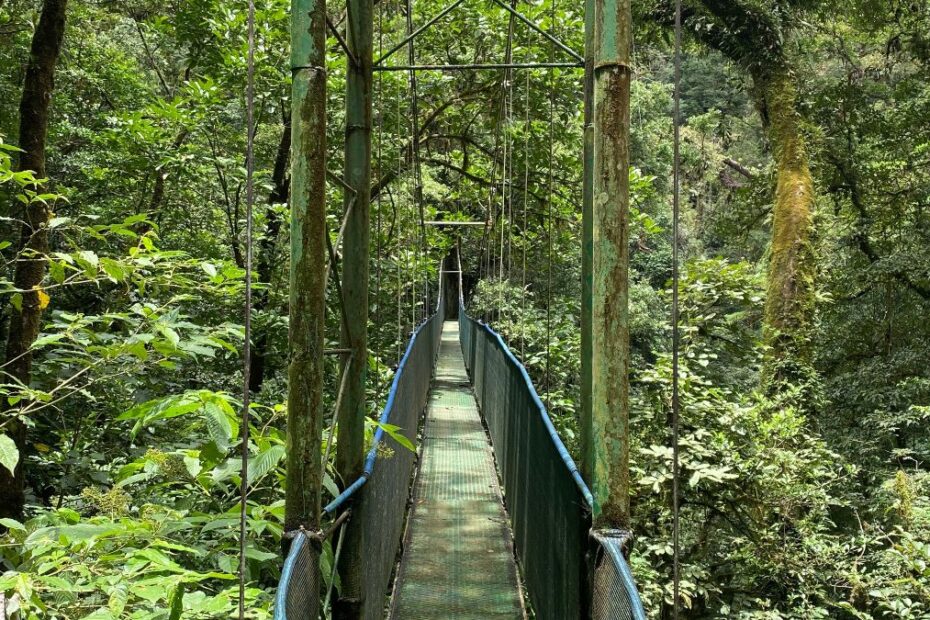
Hanging bridges take you higher into the trees, giving you a much better look at the canopy than you get from the ground. They’re particularly popular around Arenal and Monteverde. Costa Rica also helped popularize recreational zip line canopy tours, and you’ll find them in rainforest areas all over the country. Wildlife spotting isn’t really the point when you’re flying between platforms, but you do get some idea of just how tall the trees are when you’re suddenly up there among them.
Rafting the Pacuare takes you through heavily forested areas that can feel a long way from roads and towns, while calmer boat and kayak trips in places like Tortuguero and Sarapiquí move at a much slower pace.
Then there are waterfall hikes, canyoning and rappelling, aerial trams, horseback rides, and plenty of other ways to get out into the jungle. A rainforest experience in Costa Rica certainly doesn’t have to mean spending the whole time walking along a trail looking for wildlife.
What You Need to Be Prepared For
You don’t need specialist equipment for most rainforest walks in Costa Rica, but you do need to dress for the conditions. Lightweight clothing, comfortable closed shoes with good grip, and something waterproof are usually enough. Trails can be muddy and slippery, so this isn’t the place for footwear you don’t want getting dirty.
Bring drinking water and insect repellent, and consider binoculars if wildlife watching is a priority. Sunscreen is still useful even when much of the walk is beneath the canopy, particularly if the trail includes open areas.
Most importantly, be prepared for the weather to change. A dry start doesn’t mean it will stay that way, and getting caught in a tropical shower is sometimes simply part of the experience.
How to Behave in the Costa Rican Rainforest
Most of the guidelines for exploring a rainforest are straightforward. Stay on marked trails, follow any instructions from guides or park staff, and leave plants, rocks, and anything else you find where it is.
Give wildlife space and never feed or touch animals. Feeding can change their natural behavior, while getting too close for a photograph can cause unnecessary stress. If you do come across something interesting, keep your voice down and let the animal decide whether it wants to stick around.
Finally, take everything you bring into the forest back out with you. The basic rule is simple: enjoy what’s there without leaving much evidence that you were there at all.
A rainforest walk isn’t really about how many animals you manage to tick off a list. You might have a morning packed with wildlife sightings or spend much of the time listening, looking, and waiting for something to appear.
Either way, spending a few hours in the forest gives you a much better sense of what makes these places so interesting. And once you’ve walked through one with someone who knows what they’re looking at, chances are you’ll start noticing things you would previously have walked straight past.