The Panama City carnival is back this weekend! From Friday, February 13 through Tuesday, February 17, here are some tips on how to handle it like a boss.
I woke up on Ash Wednesday after what felt like a four-day bender, grabbed some water, flicked on the fan and went straight back to bed. I pulled a pillow over my head to block out the new day, my ears still ringing from the music hours earlier. The Panama City Carnival was over for me.
Later that afternoon, I would head out for a hearty bowl of healing sancocho, the perfect hangover comfort food. This was not a time for me to abstain from meat despite the point of all the partying and Lent – “Bad Catholic!”
The annual carnival is by far Panama’s biggest party and national celebration, surpassing Christmas and New Year. It’s kind like Thanksgiving, in that families get together for the event, heading to beaches or the countryside together. With so many leaving the city for hometown gatherings and carnivals elsewhere, the streets of Panama City seem eery and quiet over the holiday.
All the streets, that is, apart from those surrounding the exclusion zone around the Cinta Costera, which are closed off. The park beyond is about to erupt into the biggest carnival in Central America.
Rio de Janeiro it is not. But a four day, full-on festivity of abandon and hedonism, it most certainly is!
While nursing my carnival hangover, clutching that bowl of chicken and yam soup in my hands, I realized I wasn’t prepared for the carnival. Carnival had consumed me and I had learned lessons. These lessons I will now share, as next time I plan to do the Panama City Carnival like a pro.
Arrive Early
First, arrive early afternoon to beat the crowds and deal with security. Although walking around doesn’t feel dangerous, the police put a serious cordon in place. There are watchtowers, ID checks, and they search everyone who enters the event zone. You don’t want to forget your ID, or you won’t get in.
Carrying your passport around is risky and cumbersome, although the police are content with a copy. I had a copy of my wife’s and my passport on my phone, which is acceptable and held a bonus for me. They split men and women into two lines at the checkpoint, with the male line being by far the longest. As I had to leave the men’s line to show my wife’s ID on the phone, I went through with her, saving me an extra 30-minute wait with my fellow hombres.
If you carry a paper copy of your passport, keep it in something waterproof as you may well get soaked by the passing culecos (the Panama City Carnival is an excuse for a massive water fight!). You may also want to pack a dry top if you’re out all day/night, and don’t want to look like an impromptu wet t-shirt competition entrant. That white top may not be see-through at the moment, but…
Protect Your Belongings
Once inside the zone, the only people with knives are serving food, and the only ones packing heat are the police.
This does not prevent pickpockets, though. But you can buy waterproof pockets on lanyards, perfect for phones and cash, and hide well under a shirt. For larger items, I have my trusty RuitBag. This has pockets on the inside, against your body, rather than on the outside behind your back. Brilliant for crowds and subways.
So, now you’ve protected your belongings, it’s party time. But first, work out where the toilets are – you may need this information in a hurry later on. Best to locate them now, while you still have your senses about you.
Once you have your bearings, you’ll now want to grab food and beer, and find a spot of grass to eat on while there’s still space.
Having arrived early, you have time before the parade starts to layer your stomach with meat, get into the pre-party mode, enjoy the ambiance, and people-watch.
Enjoy a Meaty Treat
At the north end of the park, you’ll see a row of vendors barbecuing up a farm load of meat.
True to its name, the carnival is all about the meat. What I found odd though, is that despite the huge number of people selling food, there was no variation. It was all twisty, spiral cut, spicy sausages on sticks, or grilled chicken quarters. All washed down with dollar beers from overflowing barrels full of melting ice. All good for this gringo!
If you want anything different, though, you’ll need to bring it yourself. Whether that’s a piece of fruit, or an ice bottle cooler of Seco and your favorite mixer – think about what you might need other than meat and beer. This is super-important for the vegetarians out there.
Remember the Sunblock
Another thing to remember is sunblock and a hat. These Panama City skies – full of circling hawks – may be overcast, but will still give you sunstroke when out partying and drinking all day. Stay hydrated, and always have a bottle of water on you.
Disposable sunglasses are also a must. Leave the Ray Bans at home and buy a pair or two of dollar shades you can lose, sit on, and forget about. Same with the hat. You don’t want to wake up crying tomorrow over losing your best vintage bucket hat last night. Wear comfy shoes, and avoid sandals or flip flops – exposed toes in large crowds are asking for trouble.
The parade starts out at the south-east corner of the park and loops anti-clockwise. One good thing about this is you can watch it once on the south end, then cross the field to watch it again in the north end of the loop.
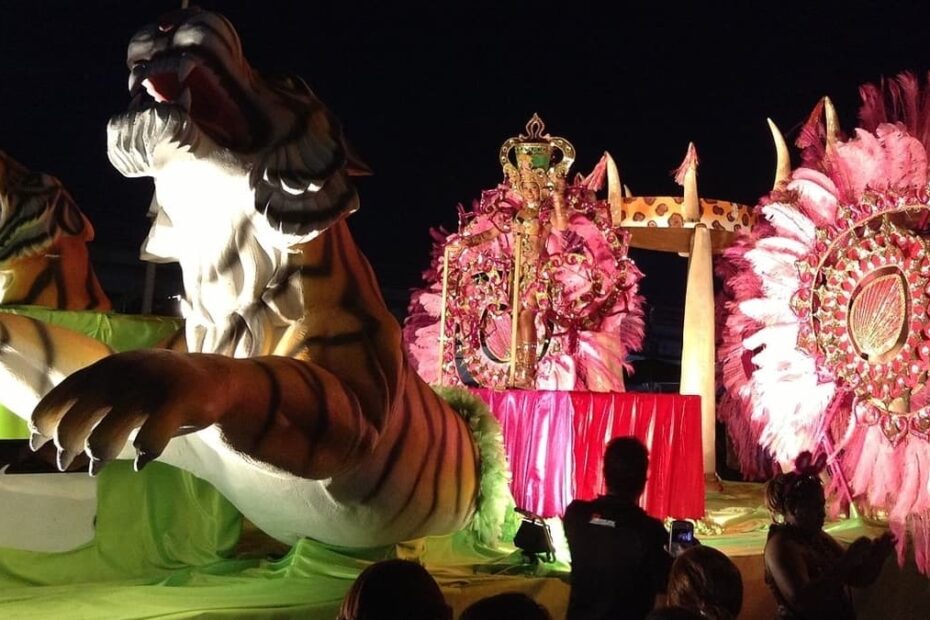
The floats (or topones) almost all contain brass bands and drums, all pumping out their own brand of salsa, Calypso, and reggae. One float carries the carnival queen and her entourage of waving princesses, while fantastic sculptures of huge, painted beings bob along on the back of trucks.
Between the floats, troops of dancers wiggling beneath their elaborate headdresses sparkle with glitter, while wearing enormous smiles that will surely hurt in the morning.
The marching bands and teams of drummers compete with those on the floats. The air becomes a chaotic melange of throbbing music.
My main advice here is to keep an eye on the floats as they pass you. Some of them throw free gifts into the crowd. This can be anything from a handful of candy, to a huge branded drink bottle which smarts when it hits you on the back of the head. The pain hurts more when someone else claims it, having bounced off your head toward them.
Evening Vibes
By now it’s getting dark, and the mood changes a notch into a more upbeat prelude to the party, that will intensify throughout the night. The live music has begun, and families with children plus the more mature/sensible revelers are leaving.
The concert will continue to around midnight, but if you’re wise, you will already have earmarked places to head to afterward to party the night away.
Leave early to explore the many clubs and bars that will go on all night. The tradition is to stay up all night, and then attend the ‘Entierro de la Sardina’ before sunrise. This Spanish custom is a symbolic burying of a sardine marking the end of Carnival. The sardine burying precedes a huge firework display, and the inevitable hangover I mentioned earlier.
Other Options Around the Country
If the craziness of Panama City doesn’t appeal, there are other carnivals around Panama happening at the same time. The most famous is in Las Tablas, where two queens representing two parts of the town battle it out. Each queen has their own bands and floats. They provoke each other and add an air of emotive folk competition to the chaos of shaving cream and blue dye fights.
If you want to go to carnival in Panama, be sure to book your stay well in advance, as hotels and Airbnbs fill up fast.
Meanwhile, in the States (outside of New Orleans, with its beads and flashing) Mardis Gras and Shrove Tuesday are tame in comparison. Back in England, we call it Pancake Day. We eat pancakes and… well, that’s it. Don’t eat pancakes, get your carnival kit on!
Panama City Carnival FAQ: What to Expect and How It Works
When is the Panama City Carnival in 2026?
Carnival in Panama City runs for five days leading up to Ash Wednesday, with the main public celebrations taking place Saturday through Tuesday. In practice, events begin on Friday night (this year, on Feb 13th) with the coronation of the Carnival Queen and opening concerts along the Cinta Costera. Festivities continue day and night across the long weekend before closing in the early hours of Wednesday with the traditional Burial of the Sardine ceremony, which marks the start of Lent.
Where does Carnival take place in Panama City?
The official Carnival zone is along the Cinta Costera and Avenida Balboa. The parade route generally runs between Avenida 3 de Noviembre near the Mercado de Mariscos and Calle 33 Este, looping anti-clockwise along the waterfront. The area is fenced and accessed through police checkpoints.
What are the daily events like?
Carnival in Panama City begins Friday night with the coronation of the Carnival Queen and opening concerts along the Cinta Costera. Saturday through Tuesday follow a steady pattern. Late mornings and afternoons are for culecos, when water trucks soak the crowd while music plays across the fenced Carnival zone. By mid-morning, most people are already wet.
In the late afternoon, parades take over. Floats known as topones move along the waterfront with brass bands, drum lines, and comparsas in costume. After dark, the parades give way to concerts, DJs, fireworks, and larger crowds. Tuesday night is usually the biggest. Carnival ends in the early hours of Wednesday with the Burial of the Sardine, marking the start of Lent.
What are culecos?
Culecos are the daytime water celebrations that define Carnival in Panama City. For several hours each morning and early afternoon, tanker trucks and fire trucks line the Cinta Costera and spray water into the crowd while music blasts from stages and trucks throughout the fenced Carnival zone. The combination of heat, loud music, beer stands, and constant soaking creates a high-energy atmosphere that feels closer to a street festival than a parade. Most people protect their phones and documents in plastic bags or waterproof pouches because everything, including you, will get wet.
Which day is the biggest?
Sunday and Tuesday tend to draw the largest crowds in Panama City. Sunday usually brings packed afternoon parades and a strong nighttime turnout, while Tuesday afternoon and evening often feature the most elaborate floats and the highest attendance before the final night concerts. Monday is generally a little less intense during the day, with slightly thinner crowds, though celebrations still continue into the evening.
Is Carnival only in Panama City?
No. Carnival is celebrated across Panama during the same dates, and many locals actually travel to provincial towns for the holiday. Las Tablas is famous for its rivalry between Calle Arriba and Calle Abajo, where competing queens and their supporters stage elaborate, loud, and extremely crowded celebrations. Penonomé is known for its water-focused festivities and a slightly more family-oriented feel. Chitré offers a mid-sized city Carnival with strong local traditions, while Bocas del Toro on the Caribbean coast has a smaller but more bohemian street-party atmosphere. Panama City remains the most urban and stage-driven version.
Do I need ID to enter the Carnival zone?
Yes. The official Carnival area along the Cinta Costera is fenced and accessed through police checkpoints. Identification is required to enter. A clear passport copy, including a digital copy on your phone, is generally accepted.
What should I wear?
Expect heat, humidity, and heavy water spray throughout the day. Light, quick-dry clothing works best, with swimwear underneath so you are comfortable staying wet for hours. Shorts with a secure waistband are more practical than long pants, and sandals with straps or old sneakers are safer than loose flip-flops on wet pavement. Cheap sunglasses and a hat are sensible choices, as items can easily be lost or damaged in dense crowds. Cotton shirts that stay heavy when soaked are best avoided.
What should I bring?
As little as possible, but keep what you carry simple and waterproof. A small pouch for your ID, card, and some cash in small bills can be worn under your shirt. Sunscreen and water are essential in the heat, and some form of phone protection is strongly recommended. Leave large cameras, jewelry, and important documents at home (or your hotel).
Can I bring bags or bottles?
Large bags, glass bottles, sharp objects, and anything that could be considered a weapon are typically prohibited within the Carnival perimeter. Security searches bags at entry points, and restricted items may be confiscated. Again, carry as little as possible to move more easily through checkpoints and crowds.
Is Carnival safe?
Police presence inside the official zone is heavy and visible, and the overall environment is controlled despite the size of the crowd. As with any large public event, petty theft can occur in dense areas. Keeping valuables secured under clothing and staying aware of your surroundings reduces risk.
What about transport and businesses?
Carnival coincides with a national holiday period, and many businesses close during the main days. Streets around the Cinta Costera close during peak hours, creating traffic congestion. Walking is often easier than driving, especially if you are staying nearby, and transport demand increases late at night.