Most travel agency FAM trips mean traveling alone and seeing four hotels a day. Fora tried the opposite in Costa Rica: one town, one week, families invited, and agents still working. Here’s how the experiment unfolded.
If you’re a travel agent, you’re used to taking the kind of work trips that make other people jealous. Hotel inspections, resort stays, destination tours, a few days in the places your clients are asking about. It sounds like a holiday someone else is paying for.
What people don’t see is the rest of it. You go alone, or with a group of other agents you met at the airport. You see four hotels in a day and remember two of them. Your partner and children stay home, because the schedule doesn’t allow for anyone who isn’t working. Agents call these FAM trips, short for familiarization, and the format has been more or less the same for decades.
It does what it’s designed to do. You come home knowing which resorts have the better rooms, which operators show up on time, and which properties you’d never put a client in. What it doesn’t tell you is what the place is like to actually be in, which matters if the people you’re selling to are families.
New York-based travel agency Fora decided to try something different. Instead of asking their agents (or advisors, as they call them) to leave their families at home, why not build an experience where they could bring them along?
That idea became Fora Summer Camp, first tested in Nicaragua in 2025 and expanded last month into a three-week event at Las Catalinas on Costa Rica’s Pacific coast. Working with Namu Travel and Las Catalinas Doorway (Las Catalinas’ own property management company), Fora brought their travel advisors and their families to Guanacaste to work, explore, meet tourism partners, and get to know the destination together.
View this post on Instagram
The Problem With the Standard Format
The summer camp idea came from Fora’s own advisors who were also parents. Co-founder Henley Vazquez says they’d told the company that traditional FAM trips were difficult when they had kids at home, and that even when bringing the family was possible, the pace made it impractical.
That’s a real constraint on who gets to learn a destination. If your best family travel specialists are also the people who can’t leave for a week, you’ve built a system that trains the agents least likely to be selling family vacations.
The fix inverted the two things that define a FAM trip. The advisors would stay in one place for a week rather than moving constantly, and they’d bring their families with them.
Last year’s Nicaragua event was the trial run. Around 15 Fora advisors went to Rancho Santana on the Pacific coast, working remotely, spending time with their families, exploring on their own, and meeting suppliers while they were there. Costa Rica was the second and bigger version: three weeks instead of two, with a new group of advisors and families arriving each week.
How It Worked
For the Costa Rica edition, Fora went to Namu, a Costa Rica-based travel company that covers most of Central America, with a list of requirements. They needed a kids’ club, accommodation at multiple price points, an airport within easy reach, activities and dining onsite, and somewhere the advisors could work. Namu proposed Las Catalinas, a car-free beach town on the Guanacaste coast with vacation homes and hotels, restaurants, beaches, and a large network of hiking and biking trails, all walkable. Coincidentally, Vasquez used to live in Las Catalinas and knows the place well, which made the idea even more attractive.
The travel advisors worked on weekdays, with co-working space available at Las Catalinas, and the program was built to fit around that rather than the other way round.
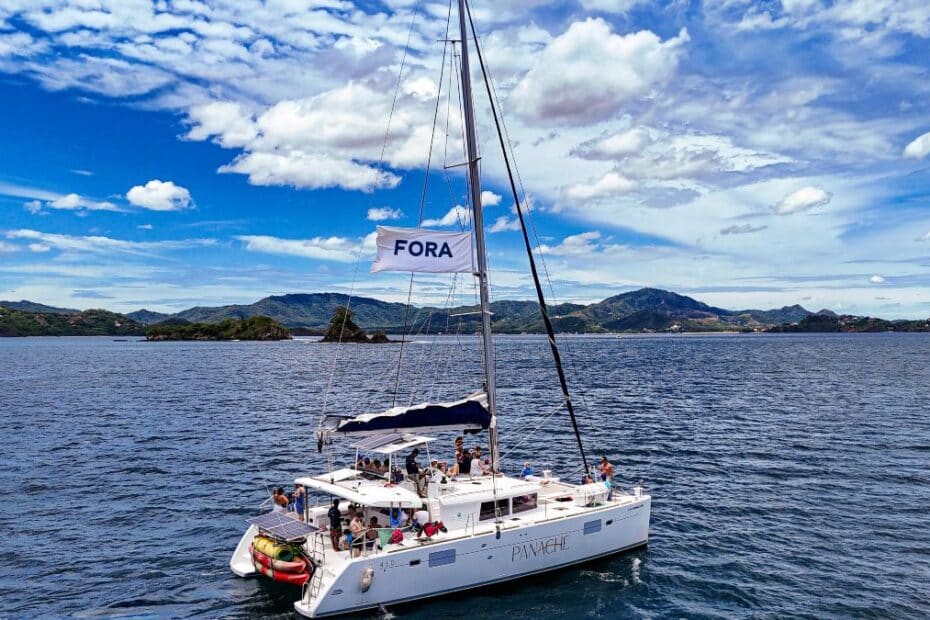
Namu ran family-friendly catamaran trips, and the wider program included a visit to the Waldorf Astoria, hikes around Las Catalinas, wellness activities, farm visits with tortilla making, scavenger hunts, and sunset gatherings. Weekends were left mostly free.
What the Advisors Learned
Here’s what a travel advisor gets from this that a conventional FAM trip can’t give them.
Inspecting a hotel tells you the pool is big and the kids’ club has staff. It doesn’t tell you whether your seven-year-old is bored by three in the afternoon. Touring a destination tells you the drive from the airport takes an hour. It doesn’t tell you what that hour is like with two children and a car seat. Trying an activity tells you it’s fun. It doesn’t tell you whether it’s fun for people who didn’t choose to be there.
At Las Catalinas, the partners and children joined most of the program and the schedule left free time for families to use as they wanted. So the advisors found out what the kids actually wanted to do, how much downtime everyone needed before it stopped being enjoyable, and how much effort it took to move a family around. That’s the knowledge that turns a recommendation from a description into advice.
Next time a client asks what Costa Rica is really like with children, those advisors have their own week to draw on rather than a hotel tour and a guess.
Keeping the Professional Side
The obvious risk with a slower, family-inclusive trip is that it becomes a vacation with a business justification attached. Fora’s answer was a Partner Expo each week, run as one-on-one meetings between their travel advisors and hotels and other tourism businesses.
The companies in the room were the same properties the advisors would be selling later. On the Costa Rican side that included Tabacón Thermal Resort & Spa, Nayara Resorts, Casa Chameleon, Andaz, and properties around the Papagayo Peninsula, alongside hotels and resorts elsewhere in Central America. Having spent the week in the country, the agents could ask the kind of specific questions that only occur to you after you’ve been somewhere.
View this post on Instagram
Did It Work?
By the only measure that counts, which is what the advisors took home, the feedback Namu received suggests it did. One said she left with “greater knowledge of the region” and already had several clients in mind for trips to multiple destinations. Another pointed to the connections and partnerships she was introduced to, and to what she’d learned about Costa Rica, its culture, hospitality, and experiences.
That’s the same outcome a good conventional FAM trip aims for. The difference is how they got there, and who was able to go.
What This Suggests About FAM Trips
Two years in, Fora has run this twice, in two Central American countries, and the model has scaled rather than collapsed. That’s more evidence than most industry experiments manage.
None of it means the standard FAM trip is finished. There’s still no better way to compare eight properties quickly, and plenty of travel agents have no reason to want their families along. But the assumption that a FAM trip has to mean leaving home alone and racing through an itinerary turns out to be a choice rather than a requirement.