There’s more than one way to experience the Panama Canal. Discover the options for a bucket-list transit, including cruises, day trips, and private boats.
A Panama Canal transit is one of those things that’s hard to appreciate until you’re doing it. A ship rises some 85 feet above sea level through a set of locks, sails across a freshwater lake in the middle of the rainforest, and is lowered back down to the other ocean through another set of locks. It’s an extraordinary feat of engineering, and it’s right here in our own region, too. Funny how much we tend to forget that.
You can make the crossing on a cruise or cargo ship, on a day trip by tour boat from Panama City, or in your own boat. This guide covers how the crossing works, what you’ll see along the way, the different ways to do it, and where to watch the canal from land.
How the Crossing Works
The canal runs northwest to southeast, so the Caribbean end at Colón is farther west than the Pacific end at Panama City, something not many people realize. That means a ship heading west towards the Pacific finishes the transit farther east than where it started. For those on a Panama Canal cruise, a full crossing takes a large ship eight to ten hours to complete.
The engineering is simple enough to follow from the deck. On the Caribbean side, the Gatun Locks lift ships 85 feet up to Gatun Lake, and on the Pacific side, the Pedro Miguel and Miraflores Locks lower them back down to sea level, using water from the lake and gravity. These original locks date from 1914 and are a tight fit, with only a few feet to spare on either side. Small electric locomotives called mules help keep the ships centered. Since 2016, ships too big for them have used a second, much larger set: Agua Clara on the Caribbean side and Cocolí on the Pacific side.
Crossing the Panama Canal From Start to Finish
Here’s what to expect on a southbound crossing, from the Atlantic (Caribbean) to the Pacific.
1. The Approach
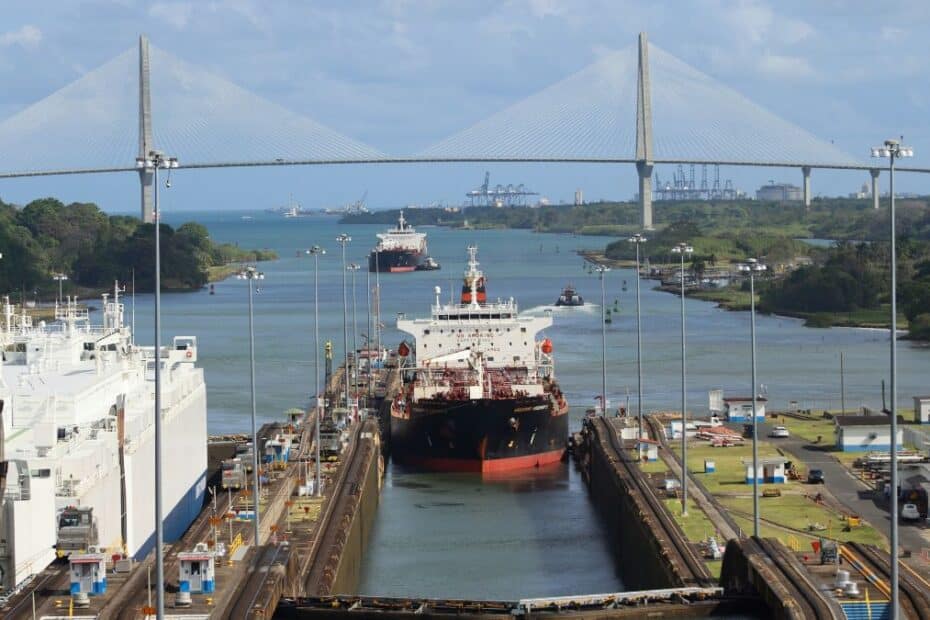
Crossing days start early. Large ships wait at anchor in Limón Bay, off Colón, for their slot, and passenger ships often start moving around dawn so the whole crossing happens in daylight. Every large vessel takes on a canal authority pilot, who directs the ship through the canal. The first landmark is the Atlantic Bridge, which opened in 2019. It spans the canal’s Caribbean entrance just before the locks and was the third bridge built over the canal.
2. The Gatun Locks
The Gatun Locks lift ships 85 feet to the level of Gatun Lake in three steps, with each chamber filling before the gates ahead open into the next. Ships using the expansion locks go through Agua Clara, just to the east, which makes the same climb in three larger chambers.
3. Gatun Lake
Gatun Lake was created in 1913 when engineers dammed the Chagres River, and at the time it was the largest artificial lake in the world. The flooding left the old hilltops as islands, and ships follow a marked channel between them for about 20 miles, with rainforest running down to the water on both sides. The lake is also known for its peacock bass, a South American fish introduced decades ago and now a target for anglers.
4. The Culebra Cut
At Gamboa, where the Chagres River enters the canal, the channel narrows into the Culebra Cut. It runs about 8.5 miles through the Continental Divide and was the hardest part of the canal to build. Repeated landslides buried equipment and undid months of digging, and the stepped slopes along the banks are there to hold the hills back.
The Americans renamed it the Gaillard Cut after David Gaillard, the engineer in charge of the excavation, who died before the canal opened. Panama restored the original name after taking control of the canal. The Centennial Bridge, opened in 2004, crosses near the southern end of the cut.
5. Pedro Miguel and Miraflores
The descent to the Pacific starts at the Pedro Miguel Locks, which lower ships about 31 feet in a single chamber. A short crossing of Miraflores Lake follows, and then the Miraflores Locks lower ships the last 54 feet to sea level in two steps.
The Miraflores Visitor Center has viewing decks right next to the chambers, so you may find people watching from close range as you go down. Ships in the expansion locks bypass both. They follow a separate channel past Miraflores Lake to the Cocolí Locks, which do the descent in three steps.
6. Out to the Pacific
Past Miraflores, the channel runs alongside the container cranes at the Port of Balboa and passes under the Bridge of the Americas, which carries the Pan-American Highway over the canal. It opened in 1962, and its height sets a limit on the ships that can pass beneath it. Some cruise ships fit the expansion locks but are too tall to pass under the bridge.
On the far side, the Panama City skyline and the Amador Causeway appear to the east, and the crossing is over.
View this post on Instagram
Ways to Cross
On a Cruise Ship
Cruise ships cross in both directions, so the way you go depends on where your voyage starts. Cruises often sail between Florida and California or Florida and Alaska, calling at ports in Central America and Mexico along the way. Others head out across the Pacific to Hawaii, other islands, Asia, or Australia. Coming the other way, some tour the Caribbean before heading to the U.S. East Coast or even Europe.
Not every ship goes all the way through, though. Some make a partial transit, turning around in Gatun Lake, and others stop at Colón without entering the locks at all, so check that the itinerary says “full transit.”
Ships narrow enough for the original locks may use them, while newer, larger vessels use Agua Clara and Cocolí. The maximum permitted beam for the original locks is approximately 106 feet, although other dimensional restrictions also apply.
On the day, the decks at the front fill up in the locks and empty out between them, so there’s no need to stand at the rail all day. Go and get lunch, find some shade, and wander back when the narrator says something’s coming up.
On a Day Trip From Panama City
Tour boats carrying large groups of passengers make two kinds of trip through the canal, and both put you much closer to the water than a cruise ship does. Small boats often share a lock chamber with a cargo ship, so you look up at the hull rising or falling beside you.
The partial transit covers the Pacific end: the Miraflores and Pedro Miguel locks, Miraflores Lake, and the Culebra Cut. It generally takes five to six hours, with the boat leaving from the Amador Causeway or from Gamboa and a bus covering the other end of the trip. Departures are usually early in the morning, although schedules depend on the direction of travel and canal traffic. Meals are generally included, and you can book directly with the operators or through local tour companies.
The full transit covers the whole canal in a day, between the Pacific and the Caribbean. Trips generally depart early in the morning and reach the opposite coast in the late afternoon, followed by a bus transfer back to Panama City. That makes a 12-hour day at least, and it can run late into the evening. Full transits operate less frequently than partial trips, so it’s worth booking well ahead.
Tour boats fit in around commercial traffic, so the canal authority sets their schedule and the exact departure time may only be confirmed shortly beforehand. Expect some waiting at the locks. Trips can occasionally be shortened or rescheduled because of canal operations, so check the operator’s conditions before booking.
On the Panama Canal Railway
You can also travel alongside much of the Panama Canal without setting foot on a boat. The Panama Canal Railway crosses the isthmus from Panama City to Colón, running alongside the canal for much of its 47 miles.
It opened in 1855 to carry gold rush travelers on their way to California and was rebuilt in 2001. Along the way, the line passes the locks and ships in the canal, runs through rainforest, and crosses stretches of Gatun Lake.
The railway operates special passenger excursions on selected dates, usually at weekends, rather than a regular daily tourist service. These are typically round trips from Panama City to Colón and back, with little time to explore Colón itself. Some services offer a dome car with a curved glass roof for an almost panoramic view. For the best views of the canal and the lake, sit on the left side heading to Colón. Check the railway’s current schedule before making plans, as departures are limited and can change.
In Your Own Boat
Crossing the Panama Canal isn’t only for big cruises and cargo ships. They’re the ones that look the most exciting from the visitor centers at the locks, but plenty of smaller, private boats come through too. Think round-the-world yachtsmen or pleasure boats moving between oceans. It beats going around Cape Horn and saves a lot of time.
For a small boat, the locks are the part that takes some handling. You usually sit in the middle of the chamber, held in place by four long lines, two at the bow and two at the stern, running up to the top of the lock walls. Canal workers throw down light lines from above, your crew tie on the heavy ones, and as the water rises or falls, the line handlers take in or let out slack to keep the boat centered.
The water churns as the chamber fills, and there’s often a cargo ship in there with you, so the handlers need to pay attention. Sometimes yachts are rafted together or tied alongside a tugboat instead.
Arranging Transit
That’s why you need four line handlers on top of the skipper, four suitable mooring lines, and substantial fenders, often made from old tires wrapped in plastic. Equipment can be rented locally, and sailors waiting for their own turn sometimes volunteer as line handlers to see how it’s done.
A canal authority advisor rides along on smaller vessels, while larger boats may require a pilot. You’ll also need to provide meals and suitable facilities for the person assigned to your boat. Vessels must meet the authority’s operating requirements, including being able to maintain sufficient speed for the scheduled transit. Depending on the direction and arrangements, you may spend the night in Gatun Lake before completing the crossing.
To arrange a transit, you’ll need to register your boat with the Panama Canal Authority, provide its details, arrange an inspection, pay the fees, and secure a crossing date. The authority publishes an official guide called Procedures for Securing a Handline Transit of the Panama Canal, which walks you through the process, including the online registration and scheduling procedures. For a boat under 65 feet, the published 2026 charges total $2,915 before the refundable $1,060 buffer deposit, making the initial payment $3,975. The charges rise with vessel length, and hiring an agent or renting equipment adds to the cost.
Waiting times vary with traffic and available slots, so allow some flexibility rather than planning around a guaranteed crossing date.
Seeing the Canal From Land
You don’t have to go through the canal to appreciate it. The Miraflores Visitor Center, on the edge of Panama City, has viewing decks right beside the locks, close enough to watch the mules take up their cables, plus an IMAX film.
On the Caribbean side, the Agua Clara Visitor Center overlooks the expansion locks, and the nearby Atlantic Bridge provides another view of the canal’s Caribbean entrance.
Back in Panama City, the Mirador de las Américas lookout, at the western end of the Bridge of the Americas, has a clear view of the Pacific entrance. Another bridge is under construction farther north. For ships waiting their turn at anchor, walk or cycle out along the Amador Causeway.
Before visiting either lock complex, check the daily transit schedule. There’s little point arriving at a viewing deck when no ships are due through.
View this post on Instagram
Final Thoughts
For something that handles around 5% of world trade, the canal is surprisingly easy to get close to. You can cross it on almost anything that floats, ride a train alongside it, or watch from a viewing deck a few feet from the ships. Much of it can be done in a day from Panama City, although a full transit deserves a day of its own.
If you go, read The Path Between the Seas by David McCullough first. It won the National Book Award in 1978, remains one of the best histories of the canal, and makes the crossing a lot more interesting.
And if you live in Central America and have never made the trip, it’s well worth putting right.