Are you thinking of buying land in Costa Rica? Here’s what to check before you buy a lot or finca, from water and legal access to land use, boundaries, and the cost of owning it.
Have you ever dreamed of buying a patch of land in the middle of nowhere, miles away from everyone, and turning it into your own private little kingdom? It’s certainly an attractive idea in this day and age. An idea that becomes more attractive every time you check out the news.
Down here in Costa Rica, tourists and travelers often talk about their desire to buy a patch of jungle and homestead it, growing everything they need to survive. That’s one romantic, if somewhat extreme, version of buying land here. But it got us thinking about buying raw land in general, as opposed to buying real estate with a home already built on it, and how it all works.
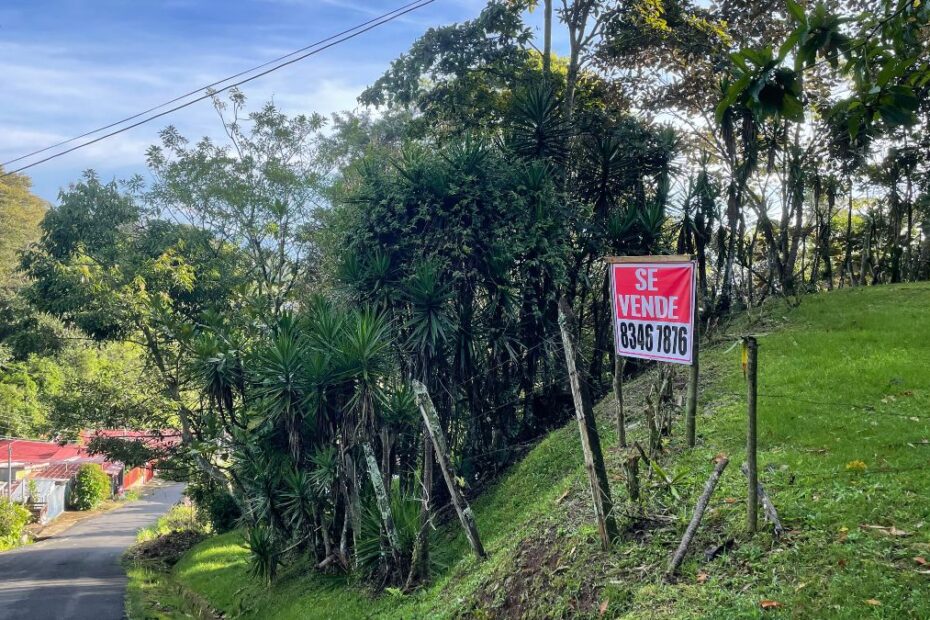
After all, Se Vende signs are everywhere, advertising everything from ordinary roadside lots to larger fincas. Then there are the prepared homesites in residential developments, particularly around Costa Rica’s beach communities. Not everyone buying land wants to disappear into the jungle. Some people simply want a lot where they can eventually build the home they want.
Whatever the plan, buying an empty piece of land raises a different set of questions from buying an existing house or condo. You’re not really looking at what you’re buying so much as what you hope it can become. And that’s where the practicalities matter. Let’s take a look at some of them.
First, Can Foreigners Buy Land in Costa Rica?
Yes they can. This whole article would be moot, otherwise. Foreigners can buy and own titled land in Costa Rica with essentially the same property rights as Costa Rican citizens. You don’t need to be a resident, either.
The main exception here involves land within Costa Rica’s Maritime Zone (Zona Marítimo Terrestre). Much of the land within 200 meters of the high-tide line operates under a concession system rather than normal titled ownership, and different rules apply to foreign buyers. It’s something to be aware of if you’re considering land near the beach.
For most titled land away from the Maritime Zone, though, being a foreigner isn’t the issue. The more important question is what you’re buying and what you intend to do with it.
What Kind of Land are You Buying?
Buying land in Costa Rica can mean, say, buying a small empty lot in an established neighborhood, a prepared homesite in a residential development, a finca with several hectares, agricultural land, or a remote property with few services and limited access. Some land is ready to build on, or close to it. Other properties may need considerable work before building is even an option. And the fact that a piece of land is advertised for sale doesn’t tell you what you’re allowed to do with it.
That’s why it helps to know what you want before you start looking. Building a single home is one thing, but putting several rental units on the property, farming it, opening a business, or eventually subdividing it are quite another. Work out what you want to do with it first, then find land that lets you do it, not the other way around.
One of the first things to check is the property’s uso de suelo, or land-use certificate. Issued by the local municipality, this establishes what the property can be used for under the planning rules that apply to it. It can also set out requirements affecting development, including setbacks, building coverage, density, height, frontage, and minimum lot size.
Other restrictions can affect the usable portion of the property. Rivers, streams, and permanent springs have protected areas around them, for example, while flooding, landslide risk, and other factors can affect where building is possible. Costa Rica also has strict laws governing tree cutting and changes in land use on forested property, and permits may be required even for cutting trees on other types of land. If clearing part of the property is essential to whatever you have planned, find out what’s permitted.
Does the Property Have Legal Access?
A road or track leading to a piece of land doesn’t necessarily mean you have a legal right to use it. Check how the property connects to a public road and whether any access across neighboring land is covered by a properly registered easement (servidumbre).
The ongoing dispute over access to Playa Blanca at Punta Leona is a high-profile example of just how complicated questions over public and private access can become. Your prospective finca probably won’t end up at the center of a national controversy, but the principle is worth remembering: physical access and legal access aren’t necessarily the same thing.
Access also matters for what you eventually want to do with the property. Road frontage and the type and width of access can affect building and subdivision options, so this isn’t simply a question of whether you can get your car through the gate. An agricultural property of more than 5,000 square meters reached by an easement rather than a public road, for example, may only allow a home of around 300 square meters (about 3,200 square feet), and pools and paved areas count toward that total.
For more remote land, there are practical considerations as well. A rough track that’s perfectly manageable in the dry season might be a different proposition during months of heavy rain, and if you’re planning to build, construction vehicles and materials will eventually need to get down there too.
View this post on Instagram
Where is the Water Coming From?
Water is one of the most important things to check when looking at land in Costa Rica and If you’re planning to build, you’ll need to show that the property has an approved water supply. If there’s an established water provider serving the area, find out whether it can issue water availability for the property. If it can’t, you’ll need to look at the alternatives.
That might mean a well or, depending on the property, another source such as a spring. But having water physically present on the property doesn’t automatically give you the right to use it. Wells and other water sources are regulated, with permits and concessions required. A new well, for example, requires permission to drill as well as a concession to use the groundwater, a process that can take up to a year.
If a property is being sold with an existing well or another concessioned water source, verify that everything is legal and current rather than simply taking the seller’s word for it.
What About Electricity, Internet, and Other Services?
Then there’s power and internet, which you don’t think about until you’re standing on a lot with neither.
Check where the nearest electricity connection is. A power line somewhere along the road doesn’t necessarily mean electricity is already available at the property itself, and getting power to the building site may involve additional infrastructure if the nearest connection point is some distance away.
Internet is more flexible, particularly now that satellite internet provides another option in places without fixed-line service. But if reliable internet matters to you, especially if you’re planning to live and work on the property, check what’s genuinely available rather than assuming you’ll sort it out later.
Do the Title and Boundaries Check Out?
Before you buy, have your own attorney check the property at the Registro Nacional, Costa Rica’s national property registry. It shows who owns the land and whether there are any mortgages, liens, or other claims against it, so you know the seller actually has a clean property to sell.
You’d think knowing where your land starts and ends would be the easy part. It often isn’t in Costa Rica.
The property should have a registered cadastral plan, or plano catastrado, showing its dimensions and boundaries. But particularly with larger fincas and older properties, don’t assume that what’s happening on the ground necessarily matches what’s on that plan. Boundary discrepancies, overlaps with neighboring properties, and encroachments can occur.
That’s where a proper survey comes in. If you’re buying land, particularly a larger or less clearly defined property, having a surveyor confirm the boundaries can identify problems while you’re still carrying out due diligence rather than after you’ve bought it. If you find the the survey doesn’t match the registered plan, find out why and what needs to be corrected. The important thing is to know that the piece of Costa Rica you’re standing on is actually the same piece of Costa Rica described in the paperwork.
Look at the Land, Not Just the View
It’s easy to stand on a beautiful piece of land and start imagining the house you’ll put there. Spend some time looking down as well as out, though.
Slope, drainage, soil conditions, and the general topography of the property can all affect how straightforward it will be to build. Think about where a house could realistically go, where the driveway would run, and how construction vehicles would reach the site. A steep hillside might offer a fantastic view, but it could also mean considerably more excavation, retaining walls, and site preparation.
This is where an architect or engineer more than earns their money. If you’re seriously considering a piece of land for a future home, having a professional look at it can help determine whether what you’re imagining is actually practical. Depending on the property, they may also recommend a soil study, which is definitely worth doing before you buy rather than after. Skip it, and you could find out too late that the ground needs deeper foundations than you planned for, which can add tens of thousands of dollars to the cost of building.
Flooding is another consideration, particularly around rivers and low-lying land. Even away from obvious flood zones, pay attention to where water runs and collects across the property.
If possible, check out the land during both dry and rainy seasons. A property can look very different after several hours of heavy September rain than it does on a sunny January afternoon. The rainy season can reveal drainage issues that simply aren’t obvious during the dry months.
Finally, ask around. Talk to the neighbors. They’ll know whether the road washes out, whether the water supply holds up in the dry season, and whether there are any disputes over boundaries or access.
Buying a Lot in a Development
Not all empty land in Costa Rica involves figuring out wells, access roads, and electricity connections yourself. If you’re buying a homesite in a residential development, much of that infrastructure may already be in place.
But find out what’s actually completed rather than what’s planned or promised. Are the roads finished? Is water availability confirmed for your lot? Is electricity already there and ready to connect? What about drainage and other common infrastructure? A rendering of what the development will eventually look like isn’t the same thing as infrastructure that’s already on the ground.
You’ll also want to understand the rules that come with owning the lot. Developments can have architectural or building restrictions covering what you can build, as well as HOA or maintenance fees and rules governing common areas. Find out who is responsible for maintaining private roads and other shared infrastructure, and what those obligations will cost you.
Can You Subdivide it Later?
If you’re buying a larger property, you might already be thinking about dividing it into smaller lots later. Don’t assume that owning ten hectares means you can simply draw a few lines through the finca and sell the resulting pieces.
Costa Rica has specific rules governing subdivision, or fraccionamiento, with requirements that can depend on factors including road access, water availability, location, and how the resulting lots will be used.
If subdivision is part of your plan, find out what’s possible before you buy.
What Will It Cost?
Start with the price itself. Costa Rica has no single listing system covering the whole market, real estate agents don’t need a license, and the same lot can turn up with different agents at different prices. Asking prices are often set with foreign buyers in mind, so compare similar properties in the area and ask around about what land nearby has actually sold for.
Bank financing for land is difficult for foreigners, so most property purchases are paid in cash. Closing costs, including transfer taxes and registration fees, add a few percent on top of the price. After that, property tax is low.
Empty land still needs looking after, though. Municipalities can require owners to keep lots cleared, and a property nobody visits can attract squatters, who can be slow to remove. If you’re buying land you won’t be living on for a while, think about who will keep an eye on it.
Is Buying Land in Costa Rica for You?
For some people, starting with an empty piece of land is exactly the appeal. You get to choose the property first and then, within the considerations we’ve discussed, decide what you want to do with it. Maybe that’s building a home exactly where and how you want it, starting a small farm, or even creating that patch-of-jungle retreat we mentioned at the beginning. It’s a real adventure for those with the appetite for it (not to mention patience and money).
Before you get too far into the plans, though, think about what daily life on the land would actually look like. How far is it to a grocery store, a clinic, or a hospital? What’s the nearest town like outside the tourist season? A remote property can feel very different after a few months of living there than it did on a weekend visit.
If that sounds like part of the fun, buying land in Costa Rica gives you plenty of possibilities. If it sounds like a headache, there’s nothing wrong with buying a house or condo where most of these considerations have already been addressed.