Cooking gas cylinders are part of everyday life in Central America. In this article, we look at why LPG is so widely used and how the system differs from natural gas.
The other day burglars robbed my home in Costa Rica. Unfortunately, that’s not especially unusual anymore. They didn’t get into the house, just an outside area, and didn’t take much. Some tools, washing powder of all things, a few towels.
Oh yeah, and my cooking gas cylinder.
We have a semi-outdoor area with a spare gas oven, barbecue, and some patio furniture. It never really occurred to me that anyone would want to steal the gas cylinder for the oven. After over a quarter of a century living in this part of the world, I know that sounds naive.
But it turns out cooking gas cylinders are a common target for thieves. In many cases, they specifically look for them, as they’re easy to sell. Which got me thinking, as I went through the rigmarole of buying a brand new cooking gas cylinder for the very first time: what the heck are these things all about, anyway?
View this post on Instagram
So What Actually is Cooking Gas in Central America?
Like many foreigners, I spent years thinking of these as “natural gas cylinders” before recently realizing they’re not natural gas at all. Thanks, ladrones, for the education!
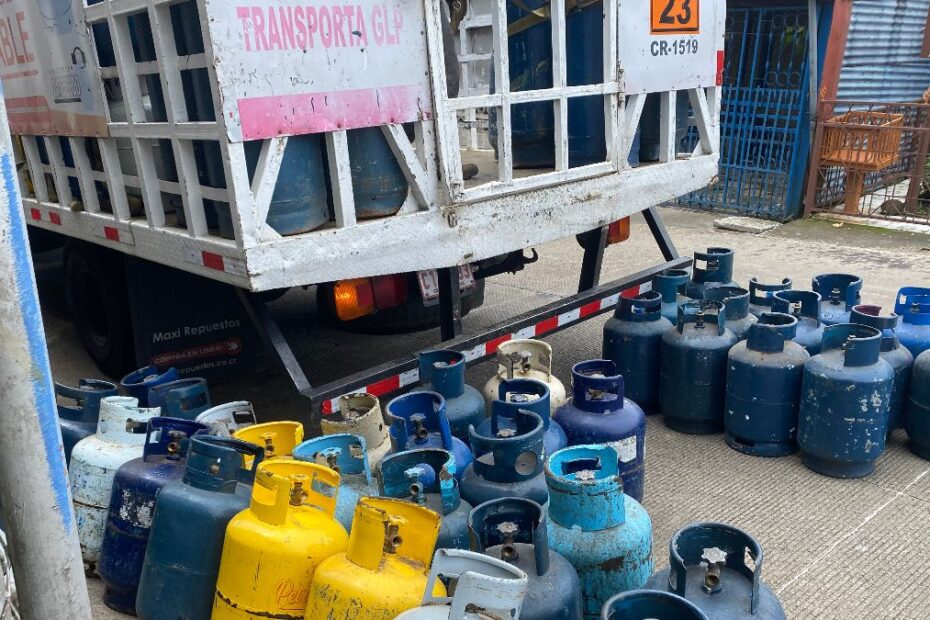
The metal cylinders commonly used in Costa Rica and across Central America actually contain LPG, or Liquefied Petroleum Gas. Usually a propane or propane-butane mix, they compress LPG into portable tanks that can easily be transported, exchanged, and stored.
So, what is natural gas, what’s LPG, and what’s the difference anyway?
Natural Gas
Natural gas is a naturally occurring fossil fuel found underground. It’s made up mostly of methane gas, extracted through drilling. In countries with natural gas infrastructure, it comes directly into homes through underground pipeline systems. Most people never physically see it because it arrives continuously through pipes connected to the property, much like water.
This is the system common across much of North America and parts of Europe.
LPG
LPG is produced during oil refining and natural gas processing. As mentioned above, it’s usually made from propane or butane gases, separated, processed, and compressed into liquid form under pressure. That’s what allows it to be stored inside portable steel cylinders like the ones seen throughout Central America.
Unlike natural gas, LPG is specifically designed to be transported. Large quantities can be shipped by tanker, stored at fuel terminals, loaded onto trucks, distributed to supermarkets and local stores, and eventually connected to somebody’s stove or barbecue at home. And here’s another thing many foreigners probably don’t realize: most of the LPG used in Central America actually comes from the United States, particularly from Texas and Louisiana.
In other words, many of those cooking gas cylinders seen throughout Central America ultimately started their journey in the United States before being shipped south and distributed throughout the region.
So What’s the Main Difference?
The main difference is really infrastructure. They design natural gas to move continuously through permanent underground pipeline systems and design LPG to be portable.
That portability is one of the main reasons LPG became so common not only across Central America, but across much of the developing world. Building huge residential gas pipeline systems here would be enormously expensive and difficult to maintain.
Everyday Life With Cooking Gas
One thing that struck me after mine was stolen was the realization that I had never actually bought a brand new gas cylinder before. Like many people here, I had simply spent years exchanging empty cylinders for full ones whenever needed.
That’s how the system largely works throughout Central America. When the gas runs out, you take the empty cylinder to a supermarket or local shop and exchange it for another full one. Or you pay someone to bring you a full cylinder and take the empty away. Buying a completely new cylinder is much more expensive because you’re paying for both the steel tank and the gas inside it. This is why they’re so tempting to thieves.
The cost varies from country to country. My new cylinder, full of LPG, came to around $80 here in Costa Rica. Exchanging an empty cylinder for a full one costs about $12 or $13 plus another couple of bucks for delivery if you don’t collect it yourself. Governments around the region often regulate prices or subsidize cooking gas because they deem it to be an essential household utility.
The exact cost varies from country to country. Honduras has some of the cheapest LPG in the region thanks to government subsidies, while Costa Rica is generally among the more expensive countries.
Personally, I still prefer cooking with gas. And despite having lived here for more than 25 years, it took having a cylinder stolen to learn far more about the system than I ever expected to.