In this article. we explore some of the most important events in Guatemala in 2026, including major religious celebrations, Indigenous festivals, and cultural events held throughout the year.
If you’re traveling to Guatemala this year, you’re in for a cultural treat! Well, we could say that about traveling to Guatemala any year, of course. But Guatemala is definitely seen as more of a “cultural destination” than other parts of Central America, and the country’s religious observances, indigenous festivals, and contemporary arts events reflect this. Some of these events are internationally recognized, while others remain deeply rooted in local traditions that continue to shape daily life.
For travelers, understanding when these events take place can add context to a visit, offering insight into Guatemala beyond its landscapes and archaeological sites. Below are some of the most notable events in Guatemala in 2026, followed by a selection of additional festivals worth knowing about.
1. Bienal de Arte Paiz (ongoing until mid-February)
The Bienal de Arte Paiz is Guatemala’s leading contemporary art event and taking place right now, having started in November. Centered primarily in Guatemala City with some venues in Antigua, the Bienal spans multiple venues, including museums, cultural centers, and public spaces. Exhibitions typically feature a mix of visual art, installations, multimedia projects, and experimental works by Guatemalan and international artists. Themes often address social issues, history, identity, and contemporary challenges facing the region.
Unlike traditional festivals tied to fixed dates or religious observances, the Bienal unfolds over several months, allowing visitors to experience it at different stages. It also serves as a reminder that Guatemala’s cultural life extends well beyond its traditional celebrations, highlighting a healthy and evolving contemporary arts scene.
View this post on Instagram
2. Semana Santa (March)
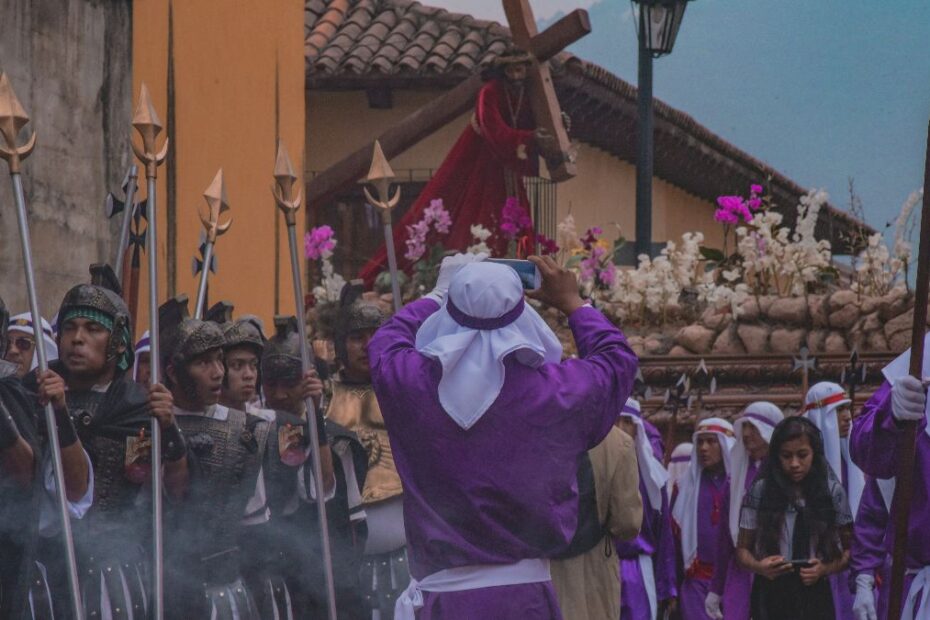
Semana Santa is Guatemala’s most prominent religious celebration of the year, and this year takes place in March, with the main processions centered on the week leading up to Easter Sunday (March 29). While Holy Week is observed in towns and cities across the country, the historic city of Antigua is the most widely visited destination for the festival.
During Semana Santa, large religious processions move through Antigua’s cobblestone streets, often accompanied by traditional music and deep local participation. One of the defining features is the creation of alfombras, intricate carpets laid on the streets made from colored sawdust, flowers, pine needles, and other natural materials. These are prepared in the days before processions begin and are a visual highlight for both participants and visitors.
For travelers in Guatemala in March, Semana Santa is a period when many towns feel noticeably different — streets may close for processions, hotels book up early, and the atmosphere shifts toward pilgrimage and observance. Experiencing Antigua during Holy Week offers a clear window into how traditional religious and cultural practices continue to shape daily life in parts of the country. And while the whole of Central America celebrates Semana Santa, it’s worth pointing out that Guatamala really does it bigger and better!
3. Cobán National Indigenous Festival (July)
The Cobán National Indigenous Festival, also known as Rab’ín Ajaw, takes place each year in July, with the main events held in the city of Cobán in Alta Verapaz. The festival typically concludes on the last Saturday of July and is widely regarded as Guatemala’s most important national Indigenous cultural celebration.
Rab’ín Ajaw combines a multi-day folkloric festival with ceremonies, traditional dances, and cultural presentations representing Maya communities from across the country. At the center of the event is the election of a young indigenous woman as Rab’ín Ajaw, meaning “Daughter of the King,” who serves as a symbolic cultural ambassador for Maya peoples during her term.
Unlike conventional beauty contests, the Rab’ín Ajaw election focuses on cultural knowledge, language, and leadership. Participants deliver speeches in both Spanish and their own Maya languages on preselected cultural and social topics before judges select the winner. The festival draws large public audiences, with recent editions welcoming well over one hundred Indigenous representatives from different linguistic and regional backgrounds.
View this post on Instagram
4. Giant Kite Festival (November)
Known locally as the Festival de Barriletes Gigantes, the Giant Kite Festival is one of Guatemala’s most emblematic cultural events, blending Maya beliefs with Catholic All Saints’ Day and Day of the Dead observances. The festival takes place every year on November 1 in the communities of Sumpango and Santiago Sacatepéquez,
Cemetery visits form a central part of the day’s traditions. Families clean and repaint tombs, decorate graves with flowers and candles, and gather to share food in remembrance of the dead. Giant kites are part of this ritual landscape, with local belief holding that they help communicate with or protect against spirits, symbolically linking the living and the dead through traditions rooted in Maya cosmology and later Catholic influence.
Barriletes are enormous circular or polygonal constructions made from tissue paper, cloth, and bamboo, sometimes reaching 10 to 20 meters in diameter. Many are not intended to fly but are displayed upright like temporary murals, featuring detailed imagery and messages related to ancestry, social concerns, environmental themes, and community values.
On November 1, fields and hillsides near cemeteries fill with towering kites, smaller flying barriletes, food stalls, music, and storytelling. Declared part of Guatemala’s Cultural Heritage, the festival draws large domestic and international audiences interested in living Maya traditions and community-based popular art.
View this post on Instagram
5. Festival of Santo Tomás (December)
The Festival of Santo Tomás is held every December in Chichicastenango, and is one of the country’s most intense patron-saint fiestas. Celebrations run roughly from December 13 to December 21, culminating on December 21, the feast day of Saint Thomas the Apostle.
Activity centers on the Iglesia de Santo Tomás, a 16th-century church built on a pre-Columbian temple platform. During the festival, its steps are used for both Catholic ceremonies and Maya rituals involving incense, offerings, and prayer. Organization of the fiesta is handled by local cofradías, or religious brotherhoods, which lead processions carrying images of Santo Tomás and other saints through the town, accompanied by marimba music, drums, flutes, and near-constant fireworks.
Traditional masked dances are a major part of the celebrations, including performances that depict historical, moral, and mythic themes using heavy wooden masks and elaborate costumes. One of the most distinctive events is the palo volador, in which dancers climb a tall pole erected near the church and spin downward on ropes, a ritual linked to pre-Hispanic concepts of renewal.
Throughout the week, parades, street food stalls, temporary rides, and an expanded market turn Chichicastenango into one of Guatemala’s busiest and most crowded towns, making the festival a major regional gathering point.
Other Events Worth Knowing About
Festival de Junio (June)
A month-long cultural festival focused on music, dance, theater, and visual arts, primarily hosted at the Miguel Ángel Asturias Cultural Center in Guatemala City.
Feria de Jocotenango (August)
One of Guatemala City’s oldest and largest traditional fairs, held around August 15 in honor of the Virgen de la Asunción. The main fairgrounds line Avenida Simeón Cañas near the Hipódromo del Norte, with rides, food stalls, and markets filling the area.
Vuelta a Guatemala (October–November)
Guatemala’s premier multi-stage cycling race, attracting regional and international teams while passing through a wide range of landscapes and towns.
Wrapping Up
These events offer a snapshot of Guatemala’s cultural calendar in 2026, covering religious observances, Indigenous celebrations, and large-scale cultural gatherings. Some draw international attention, while others remain strongly local in character. For travelers, planning around these dates can provide opportunities to experience Guatemala during periods of heightened activity and public celebration.