Understanding currency in Central America is easier once you know the basics. In this article, we look at how US dollars, local currencies, cash, cards, and exchange rates actually work across the region.
Central America might be small, but with seven countries stacked on top of each other, money gets complicated. Travelers passing through the region encounter multiple currencies and exchange rates that shift up and down. Some countries use the US dollar, which keeps things easy. Others, though, use their own currencies that many travelers may be unfamiliar with before arriving. Add in ATM fees, airport exchange counters, and the common habit of mentally converting everything back into dollars, and budgeting around the region can become confusing.
The good news is that managing money in Central America is easy once you understand a few regional realities. Knowing when to carry cash, when cards work reliably, and how locals mentally calculate exchange rates can make traveling through the region much smoother and help you avoid some surprisingly common mistakes.
Quick Guide to Currency in Central America
As mentioned, Central America uses a mix of local currencies and US dollars. Panama and El Salvador use the US dollar outright, Belize keeps a fixed exchange rate with it, while Costa Rica, Guatemala, Honduras, and Nicaragua all have their own currencies. Math AI helps to estimate conversions fast and keep track of spending while moving between multiple countries. But travelers should also know that US dollars are widely accepted in most countries, especially in tourist areas.
Locals and long term expats in Costa Rica, Guatemala, Honduras, and Nicaragua also tend to use rough mental shortcuts when estimating how much a dollar is worth. These are useful for quick budgeting and understanding approximate costs, but they don’t rely on them on for exact conversions.
Belize — Belize Dollar (BZD)
Belize uses the Belize dollar, fixed at 2 Belize dollars = $1. That makes conversions super simple: cut Belize dollar prices roughly in half to estimate the US dollar equivalent (we say “roughly” because some tiny variance exists, but it’s negligible). US dollars are widely accepted throughout the country.
Costa Rica — Colón (CRC)
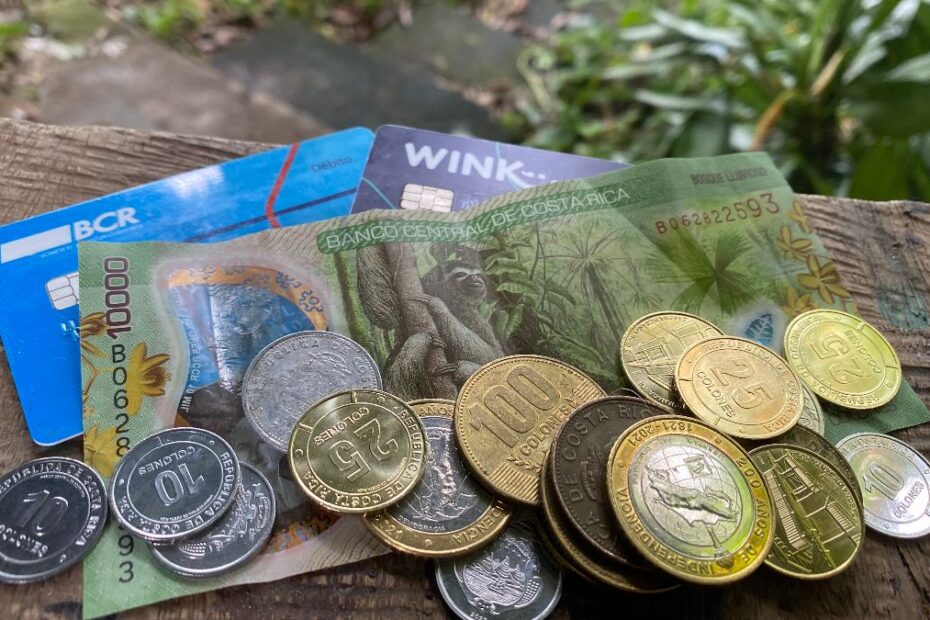
Costa Rica uses the colón, named after Christopher Columbus (Cristóbal Colón in Spanish). US dollar use is common in tourism areas, hotels, and many larger businesses. Many people still use the old (and outdated; the new normal is closer to 450 colones) 500 colones = $1 as a quick mental shortcut. Cards work pretty much everywhere, although local cash still helps for toll roads, parking attendants, local buses, small restaurants, and smaller shops.
El Salvador — US Dollar
El Salvador officially uses the US dollar, so there’s no currency conversion for American travelers. While Bitcoin gained international attention after becoming legal tender for a while, most everyday tourism transactions still get handled in dollars.
Guatemala — Quetzal (GTQ)
Guatemala uses the quetzal, named after the country’s national bird, which also holds important symbolic value in Maya culture. A common rough estimate is 8 quetzales = $1, even though the actual rate is often slightly lower than that. Cities and tourism hubs increasingly accept cards, but cash still plays an important role in markets, transportation, and rural areas.
Honduras — Lempira (HNL)
Honduras uses the lempira, named after the indigenous Lenca leader who resisted the Spanish conquest in the 16th century. For quick mental math, many people use 25 lempiras = $1 as an easy estimate. Most businesses accept cards, especially in larger cities and tourism destinations like Roatán, though cash remains important throughout much of the country.
Nicaragua — Córdoba (NIO)
Nicaragua uses the córdoba, named after conquistador Francisco Hernández de Córdoba, founder of several early colonial settlements in the country, though US dollars are also commonly used in tourism areas. A typical rough estimate is 35 córdobas = $1 (Back in the day, it always used to be 25 cords to the dollar, which made the math easier). Smaller businesses, markets, buses, and taxis usually prefer córdobas, while hotels and tourism businesses may quote prices in either currency.
Panama — US Dollar/Balboa
Panama is effectively a US dollar economy, making it one of the easiest countries in the region financially for American travelers. The balboa (named after Spanish explorer Vasco Núñez de Balboa) exists officially, but only as coins. Paper currency is US dollars, so there is no real conversion to worry about for dollar-based travelers.
View this post on Instagram
Using US Dollars in Central America
With all these different currencies, it’s really easier for travelers overloading through the region to simply use dollars and change up as they go. US dollars are, as we said earlier, widely accepted throughout much of Central America. But travelers should not assume using dollars works exactly the same way it does in the United States, especially outside of El Salvador and Panama.
In many countries, vendors expect US bills to be in very good – think pristine – condition. They’ll refuse outright to accept torn, heavily creased, marked, or damaged bills, even if they would still be accepted by businesses or banks in the United States. Larger bills also create problems. In practice, $20 bills are usually the safest maximum denomination to carry for everyday purchases.
Another thing travelers quickly notice is that paying in dollars means, in most cases, receiving change in local currency. Small businesses, taxis, roadside restaurants, markets, and independent vendors may use rough mental exchange estimates rather than the exact official rate of the day. Usually the differences are minor, but travelers should understand that these informal conversions are part of everyday commerce throughout much of the region. It’s really not worth arguing about.
Supermarkets, larger hotels, chain businesses, and formal tourism operators typically use computerized exchange systems that closely follow current rates, making pricing more predictable when paying in dollars or by card.
Cash vs Cards in Central America
Card payments are far more common in Central America than they were even a decade ago, particularly in Costa Rica, Panama, Belize, and larger tourism centers across the region. Hotels, supermarkets, larger restaurants, and most formal tourism businesses will accept major credit and debit cards without issue.
Contactless payment has also expanded rapidly in recent years. In many cities and tourism areas, travelers can now pay directly with phones, smartwatches, or tap-enabled cards through systems like Apple Pay and Google Pay without ever physically handing over a card. Costa Rica and Panama in particular have seen very widespread adoption of contactless payments.
But cash still plays an important role in day-to-day life and travel, much more so than North America and Europe. Local buses, taxis, small restaurants, markets, street food vendors, parking attendants, independent tour guides, and rural businesses often prefer or require cash. Even in countries where cards are widely accepted, internet outages and payment terminal problems are not uncommon outside major cities.
ATMs are generally easy to find in larger towns and tourism hubs, though travelers heading into remote areas, islands, or border regions usually withdraw cash beforehand. Foreign ATM fees can also add up quickly during longer trips, especially when both the local bank and the traveler’s home bank charge withdrawal fees.
Final Thoughts
Managing money in Central America is usually much easier than many first-time visitors expect once they understand a few regional realities. The key is flexibility. Carry some local currency, keep smaller US dollar bills on hand, and avoid relying entirely on cards or cash alone. We should also repeat here that exchange rates move constantly. The rough mental shortcuts people use around the region are helpful for estimating prices quickly, but they are not exact conversions and should never replace checking current rates periodically during a trip.
Most importantly, Central America is still a region where small day-to-day transactions matter. A few unfavorable exchanges, repeated ATM fees, or poor conversion rates may not seem significant individually, but over the course of a longer multi-country trip they can affect a travel budget. Understanding how money works locally usually makes traveling through the region smoother, simpler, and cheaper.