What can Costa Rica’s tourism businesses do about the strong colon/weak dollar? We look at raising prices, cutting costs, changing currencies, and taking the hit.
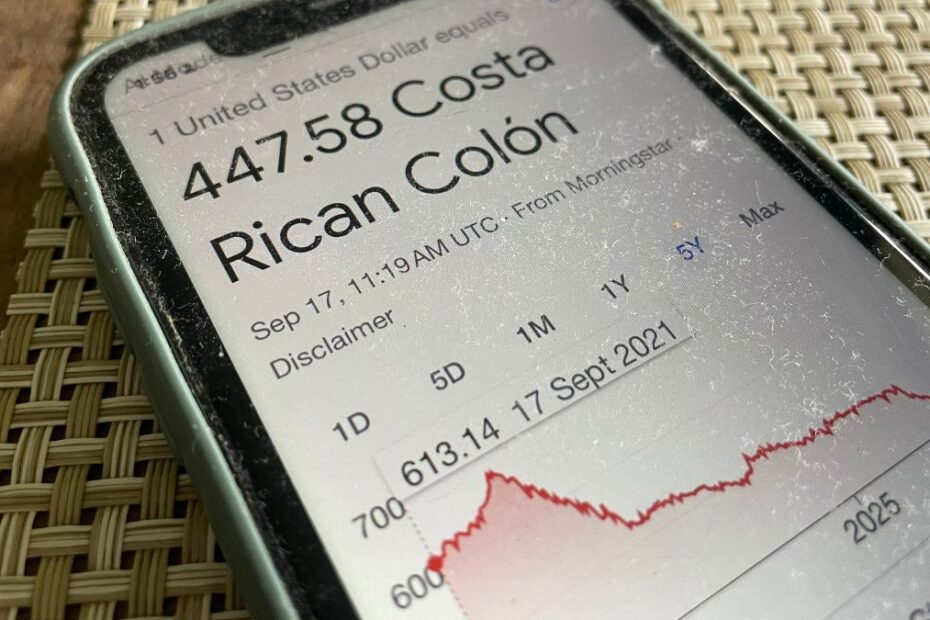
The strong Costa Rican colón is hardly a new problem for the country’s tourism industry. Hotels, tour operators, transportation companies, and other businesses have been talking about the falling dollar for a while now, and it hasn’t been above the traditional benchmark ₡500 rate since the end of 2024. But with the exchange rate dropping below ₡450 to the dollar this week, the question is becoming harder to avoid: what can they actually do about it?
Costa Rica’s international tourism industry generally sells its services in dollars while paying wages, utilities, taxes, and other operating costs in colones, wherein lies the problem. A business receiving $1,000 when the dollar was worth ₡600 could turn that into ₡600,000. At ₡450, the same $1,000 brings in just ₡450,000, even though its bills haven’t fallen by anything close to the same amount.
And businesses shouldn’t expect the government to push the dollar back up, either. President Laura Fernández said this month that her administration won’t intervene to artificially alter the exchange rate, stressing that monetary policy is the responsibility of the independent Central Bank. It’s a position she made clear before taking office and one that broadly continues the approach of the previous Rodrigo Chaves administration.
There are essentially four ways for a tourism business to respond. It can raise prices, cut costs, change the currency equation where possible, or absorb the difference through lower margins. In practice, many businesses will do some combination of all four, and none of them come without a downside.
So what do the four options actually look like for a Costa Rican tourism business going forward?
1. Raise Prices
The most obvious response to receiving fewer colones for every dollar is to charge more dollars. This is already happening. Earlier this year, the Costa Rican Chamber of Hotels acknowledged that the exchange rate was contributing to higher prices for accommodation, food, and tours.
The problem is that tourism businesses can’t simply increase their prices enough to recover everything they’ve lost on the exchange rate. Costa Rica is already an expensive destination and is becoming less competitive as neighboring countries improve their tourism offerings while remaining considerably cheaper for travelers. El Salvador is perhaps the clearest example, some 40% to 50% cheaper than Costa Rica, with its tourism industry growing rapidly in recent years. Raising prices further to compensate for the exchange rate only adds to that competitive disadvantage.
There’s also some uncomfortable timing involved. Air arrivals to Costa Rica were down 5.9% year-on-year in August, while arrivals from the United States, the country’s largest tourism market, fell almost 14%. Those figures don’t establish that higher prices or the exchange rate caused the decline, and arrivals remain, for now, up overall in 2026. With that in mind, though, it’s hardly the ideal moment to assume tourists will simply pay more rather than go somewhere else instead.
Raising prices can recover some of the money lost to the exchange rate. But how much further can prices rise before customers start looking elsewhere? Probably not all that much.
2. Cut Costs
If raising prices risks losing customers, the other obvious option is to spend less. That’s easier said than done, though, when many of the biggest expenses facing a tourism business like wages, electricity, taxes, fuel, maintenance, and local services, are paid in colones and haven’t fallen alongside the dollar.
In a letter to the Central Bank earlier this year, the Costa Rican National Chamber of Tourism (CANATUR) described a “silent adjustment” already taking place across the industry. Businesses were postponing investment and maintenance, holding back on hiring, and reducing spending on training and certifications as they tried to protect their margins.
This matters in Costa Rica because smaller independent businesses are central to the tourism model the country has spent decades building. Boutique hotels, eco-lodges, family-run properties, and independent tour companies may offer an expensive, more exclusive product, but most don’t have the financial resources of international resort groups like, say, the Ritz-Carlton or Four Seasons behind them.
And unlike a Ritz-Carlton or a Four Seasons, there are only so many costs a boutique business can cut before the customer starts noticing. Postpone renovations and rooms begin to look tired. Put off replacing vehicles or equipment and their condition starts to show or safety becomes a concern. Reduce staffing and service suffers. For a small hotel or tour operator dependent on reputation and online reviews, these are real problems.
Over the last few decades, Costa Rica has been able to command a premium partly because of the kind of tourism it offers. If the smaller businesses behind much of that experience are forced to charge more while offering less, the country risks weakening the very tourism model that helped justify those higher prices in the first place.
3. Change the Currency Equation
Here’s another answer that might seem obvious: if earning dollars while paying most expenses in colones is the problem, why not start charging customers in colones instead?
For some tourism businesses, that can work. Earlier this year, a business owner in Sámara told El Financiero that he had converted around half of his commercial rental contracts into colones, reducing some of his exposure to the falling dollar. Businesses dealing directly with Costa Rican customers can also price their services in colones relatively easily.
International tourism is more complicated. Hotels, tour operators, and destination management companies often sell through travel agencies and wholesalers abroad, with rates negotiated in dollars many months before the customer arrives. Those partners expect dollar prices, and asking a travel company in the United States or Europe to start buying Costa Rican vacations in colones isn’t particularly realistic.
The same problem applies to contracts already signed. A hotel or tour operator may be providing a service today at a dollar price agreed six months or even a year ago. If the colón strengthens substantially during that time, the business receives fewer colones than it expected when the rate was set, but it can’t simply change the agreed price.
There are other ways businesses can try to protect themselves. Where possible, they can negotiate more expenses in dollars, shorten the period for which future rates are guaranteed, or build exchange-rate provisions into contracts. Larger businesses can also use financial hedging products to lock in an exchange rate, although those products aren’t necessarily practical or accessible for the smaller businesses that make up much of Costa Rica’s tourism industry.
4. Absorb the Loss
The final option is also the simplest: don’t raise prices, don’t make significant cuts, and accept that the business will make less money. In other words, do nothing and hope the problem goes away.
For a while, that’s exactly what many tourism businesses can do. A profitable hotel or tour operator can accept a smaller margin rather than risk losing customers or damaging the quality of its product. And for services sold months in advance at an agreed dollar price, there may not be much choice anyway.
But absorbing the loss isn’t really a long-term solution. Lower margins eventually mean less money available for investment, maintenance, wage increases, expansion, or simply building up reserves for the next difficult period. Some businesses may also turn to credit to meet obligations on services they sold when the exchange rate was more favorable.
The problem is how long a business can keep doing this. At some point, something has to give.
So, What’s Going to Give?
Costa Rica’s tourism businesses can’t control the exchange rate, and the government has made clear it isn’t going to help. That leaves tourism businesses to deal with the consequences themselves.
None of the options laid out above are attractive. In fact, they’re all horrible. Raise prices and Costa Rica becomes even less competitive and tourists go elsewhere. Continue cutting costs and, at some point, the product suffers and tourists go elsewhere. Changing how currencies are handled can reduce some exposure, but it can’t eliminate it and isn’t always practical in an international market. And absorbing the difference simply means accepting lower margins, but for how long until a business becomes unviable? How long until tourism becomes an unattractive career path in the Land of Pura Vida?
Behind all of this are real businesses, jobs, and livelihoods. Across Costa Rica’s tourism industry, people are increasingly worried about what the strong colón means for their businesses, their employees, and their own futures.
Again, at some point, something has to give. The question facing Costa Rica’s tourism industry is how much can give before the destination itself starts to change.